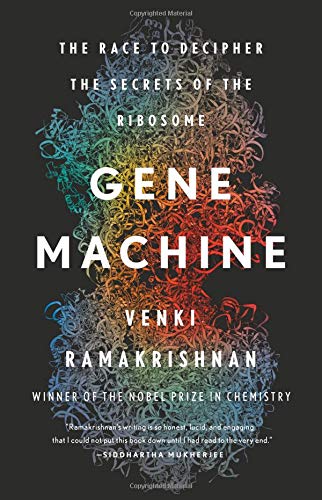
A Nobel Prize-winning biologist tells the riveting story of his race to discover the inner workings of biology's most important molecule
"Ramakrishnan's writing is so honest, lucid and engaging that I could not put this book down until I had read to the very end."--Siddhartha Mukherjee, author of The Emperor of All Maladies and The Gene
Everyone has heard of DNA. But by itself, DNA is just an inert blueprint for life. It is the ribosome--an enormous molecular machine made up of a million atoms--that makes DNA come to life, turning our genetic code into proteins and therefore into us. Gene Machine is an insider account of the race for the structure of the ribosome, a fundamental discovery that both advances our knowledge of all life and could lead to the development of better antibiotics against life-threatening diseases. But this is also a human story of Ramakrishnan's unlikely journey, from his first fumbling experiments in a biology lab to being the dark horse in a fierce competition with some of the world's best scientists. In the end, Gene Machine is a frank insider's account of the pursuit of high-stakes science.
Gene Machine: The Race to Decipher the Secrets of the Ribosome
📄 Viewing lite version
Full site ›
Book Details
Author(s)Ramakrishnan, Venki
PublisherBasic Books
ISBN / ASIN0465093361
ISBN-139780465093366
AvailabilityIn Stock.
Sales Rank22,612
MarketplaceUnited States 🇺🇸
Description ▲
Similar Products ▼
- The Breakthrough: Immunotherapy and the Race to Cure Cancer
- The Second Kind of Impossible: The Extraordinary Quest for a New Form of Matter
- The Beautiful Cure: The Revolution in Immunology and What It Means for Your Health
- The Tangled Tree: A Radical New History of Life
- The Cell: A Visual Tour of the Building Block of Life
- The Atom: A Visual Tour (The MIT Press)
- The Demon in the Machine
- A Crack in Creation: Gene Editing and the Unthinkable Power to Control Evolution
- She Has Her Mother's Laugh: The Powers, Perversions, and Potential of Heredity
- Blueprint: How DNA Makes Us Who We Are (The MIT Press)