By restricting land use and concentrating development in city centers instead of on the fringes, Safdie argues that reliance on gas-guzzling automobiles would become a nonissue. His truly is a revolutionary idea, especially for a culture that idealizes suburbia. Although some of the suggestions in The City After the Automobile might seem fanciful, any argument in favor of better planning, less pollution, and less waste of time, money, and resources makes a lot of sense.
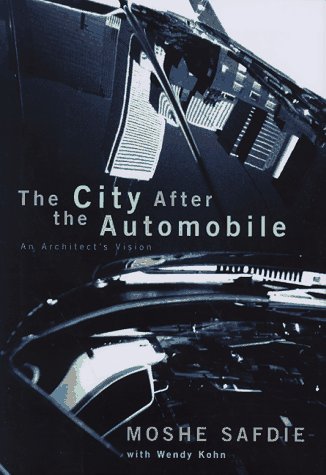
The City After The Automobile: Past, Present, And Future
📄 Viewing lite version
Full site ›
Book Details
PublisherBasic Books
ISBN / ASIN0465098363
ISBN-139780465098361
Sales Rank3,150,718
CategoryPolitical Science
MarketplaceUnited States 🇺🇸
Description ▲
Reading Moshe Safdie's book The City After the Automobile feels at times like dipping into science fiction, particularly when considering his call for publicly owned electric cars kept in storage depots and rented to the masses. Most of the book, however, is a discussion of how to revolutionize city planning in order to reduce the necessity for cars. Safdie, an architect, uses his own plans for rebuilding portions of cities around the world as the basis for his argument supporting strong land-control laws and restriction of urban sprawl. Instead of suburban shopping malls, Safdie proposes a "linear center," a central area of concentrated development that would serve as a public arena.
More Books in Political Science
The Millennium Development Goals and Beyond: Internati…
View
Transnational Networks in Regional Integration: Govern…
View
Forensic Psychophysiology Using the Polygraph: Scienti…
View
Gender, Islam and Democracy in Indonesia (ASAA Women i…
View
E-Governance: A Change Management Tool
View
Shop Floor Bargaining and the State: Historical and Co…
View
Red State Uprising: How to Take Back America
View
A Community Health Approach to the Assessment of Infan…
View
Foreign Aid and Landmine Clearance: Governance, Politi…
View