This is the definitive edition of one of the very greatest classics of all time — the full Euclid, not an abridgement. Using the text established by Heiberg, Sir Thomas Heath encompasses almost 2,500 years of mathematical and historical study upon Euclid.
This unabridged republication of the original enlarged edition contains the complete English text of all 13 books of the Elements, plus a critical apparatus that analyzes each definition, postulate, and proposition in great detail. It covers textual and linguistic matters; mathematical analyses of Euclid’s ideas; classical, medieval, Renaissance, modern commentators; refutations, supports, extrapolations, reinterpretations, and historical notes, all given with extensive quotes.
“The textbook that shall really replace Euclid has not yet been written and probably never will be.” — Encyclopaedia Britannica.
Volume 1. 151-page Introduction: life and other works of Euclid; Greek and Islamic commentators; surviving mss., scholia, translations; bases of Euclid’s thought. Books I and II of the Elements, straight lines, angles, intersection of lines, triangles, parallelograms, etc.
Volume 2. Books III-IX: Circles, tangents, segments, figures described around and within circles, rations, proportions, magnitudes, polygons, prime numbers, products, plane and solid numbers, series of rations, etc.
Volume 3. Books X to XIII: planes, solid angles, etc.; method of exhaustion in similar polygons within circles, pyramids, cones, cylinders, spheres, etc. Appendix: Books XIV, XV, sometimes ascribed to Euclid.This is the definitive edition of one of the very greatest classics of all time the full Euclid, not an abridgement. Using the text established by Heiberg, Sir Thomas Heath encompasses almost 2,500 years of mathematical and historical study upon Euclid.
This unabridged republication of the original enlarged edition contains the complete English text of all 13 books of the Elements, plus a critical apparatus that analyzes each definition, postulate, and proposition in great detail. It covers textual and linguistic matters; mathematical analyses of Euclid s ideas; classical, medieval, Renaissance, modern commentators; refutations, supports, extrapolations, reinterpretations, and historical notes, all given with extensive quotes.
The textbook that shall really replace Euclid has not yet been written and probably never will be. Encyclopaedia Britannica.
Volume 1. 151-page Introduction: life and other works of Euclid; Greek and Islamic commentators; surviving mss., scholia, translations; bases of Euclid s thought. Books I and II of the Elements, straight lines, angles, intersection of lines, triangles, parallelograms, etc.
Volume 2. Books III-IX: Circles, tangents, segments, figures described around and within circles, rations, proportions, magnitudes, polygons, prime numbers, products, plane and solid numbers, series of rations, etc.
Volume 3. Books X to XIII: planes, solid angles, etc.; method of exhaustion in similar polygons within circles, pyramids, cones, cylinders, spheres, etc. Appendix: Books XIV, XV, sometimes ascribed to Euclid.
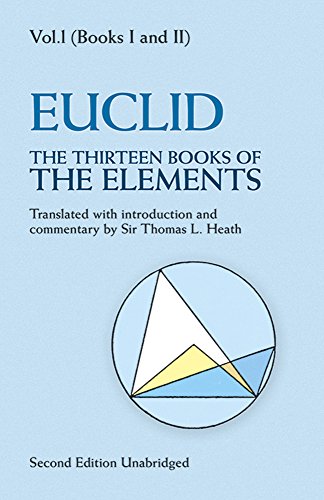
The Thirteen Books of the Elements, Vol. 1: Books 1-2
📄 Viewing lite version
Full site ›
Book Details
Author(s)Thomas L. Heath, Euclid
PublisherDover Publications
ISBN / ASIN0486600882
ISBN-139780486600888
AvailabilityUsually ships in 24 hours
Sales Rank70,511
CategoryMathematics
MarketplaceUnited States 🇺🇸
Description ▲
More Books in Mathematics
Topics in Finite and Discrete Mathematics
View
Applications of Mathematics in Engineering and Economi…
View
Linear Algebra Supplement to Accompany Calculus with A…
View
Random Matrix Models and their Applications (Mathemati…
View
Continuous Crossed Products and Type III Von Neumann A…
View
First European Congress of Mathematics Paris, July 6-1…
View
Workshop Statistics: Discovery with Data, JMP Companio…
View
XXVI International Workshop on Geometrical Methods in …
View
Social Policy Reform in Hong Kong and Shanghai: A Tale…
View