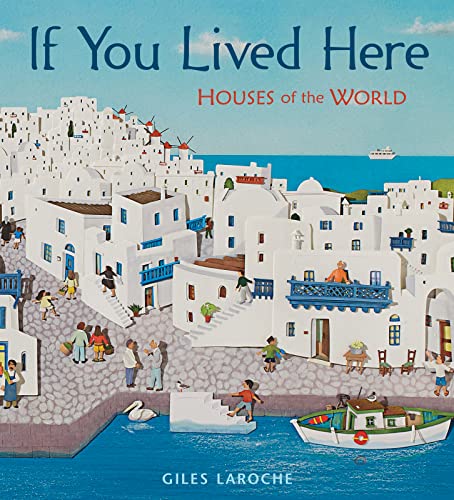
With intricate bas-relief collages, Giles Laroche uncovers the reason why each home was constructed the way in which it was, then lets us imagine what it would be like to live in homes so different from our own. Showing the tremendous variety of dwellings worldwide—log cabins, houses on stilts, cave dwellings, boathouses, and yurts—this book addresses why each house is build the way that it is. Reasons—such as blending into the landscape, confusing invaders, being able to travel with one's home, using whatever materials are at hand—are as varied as the homes themselves. List of Houses included: Dogtrot log house, based on dogtrots built in the southern U.S.
Chalet, based on chalets built in the Austrian Alps.
Pueblo, Taos, New Mexico
Connected barn, based on connected barns common in northern New England.
Cave dwelling, Guadix, Andalucia, Spain
Palafitos (house on stilts), Chiloe Island, Chile
Palazzo Dario, Venice, Italy
Chateau La Brede, Bordeaux, France
Tulou, Hangkeng village, Yongding, China
Half-timbered houses, Miltenberg am Main, Germany
Greek island village houses, Astipalaia Island, Greece
Decorated houses of Ndebele, Pretoria, Transvaal, South Africa
Yurt, based on yurts in Mongolia and other parts of central Asia.
Airstream trailer, USA
Floating house, Middleburg, the Netherlands
Tree house, USA
Photos Taken by the Author of If You Lived Here: Houses of the World
(Click on Images to Enlarge)
I will use this pencil drawing of a New England style connected barn as a guide to make my cut-paper relief illustration.
Here we can see below the drawing some of the sections under construction.
The main house section is put in place.
The large barn is connected to the small barn.
The roof shingles are added to the large barn.
Oxen, horses, cows, ducks, geese, chickens, and people are added to the finished illustration.