Search Books
Practical Voip Using Vocal COM and .NET Component Serv…

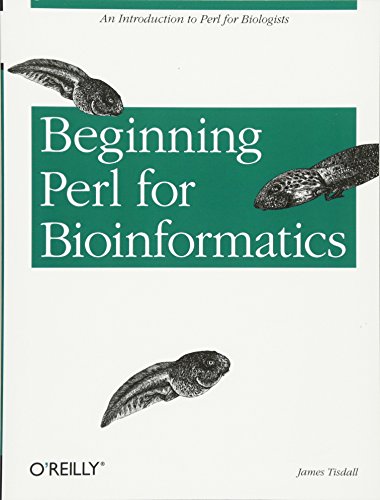
Beginning Perl for Bioinformatics

Author James Tisdall
Publisher O'Reilly Media
Category Computers
📄 Viewing lite version Full site ›
🌎 Shop on Amazon — choose country
38.75 USD
🛒 Buy New on Amazon 🇺🇸

✓ In Stock.

Share:
Book Details
Author(s)James Tisdall
ISBN / ASIN0596000804
ISBN-139780596000806
AvailabilityIn Stock.
Sales Rank397,486
CategoryComputers
MarketplaceUnited States 🇺🇸

Description

Biology, it seems, is a good showcase for the talents of Perl. Newcomers to Perl who understand biological information will find James Tisdall's Beginning Perl for Bioinformatics to be an excellent compendium of examples. Teachers of Perl will likewise find the text to be filled with fresh programming illustrations of growing scientific importance. Seasoned Perlmongers who want to learn biology, however, should search elsewhere, as Tisdall's emphasis is on Perl's logic rather than Mother Nature's.

Departing from O'Reilly's earlier monograph Developing Bioinformatic Computer Skills, Tisdall's text is organized aggressively along didactic lines. Nearly all of the 13 chapters begin with twin bullet lists of Perl programming tools and the bioinformatic methods that require them. Likewise, the chapters end with exercises. String concatenation is illustrated with gene splicing, and regular expressions are taught with gene transcription and motif searching.

Tisdall emphasizes sequence examples throughout, leading up to an introduction to a Perl interface for the NIH GenBank biological database and the widely used BLAST sequence alignment tool. After a brief discussion of three-dimensional protein structure, he returns to sequence extraction and secondary structure prediction.

Tisdall's goal is to boost the beginning programmer into a domain of self-learning. He imparts essential etiquette for the success of programming newbies: use the wealth or resources available, from user documentation to Web site surveys to FAQs to How-To's to news groups and finally to direct personal appeals for help from a senior colleague. A well-plugged-in bioinformatics Perl student will soon discover Bioperl, an open-source effort to bring research-grade bioinformatic tools to the Perl community. Bioperl is described briefly at the end of Tisdall's book and will reportedly be a forthcoming title of its own in the O'Reilly bioinformatics series.

Although he introduces bioinformatics as an academic discipline, Tisdall treats it as a trade throughout his book. He indicates that open questions and computational hard problems exist, but does not describe what they are or how they are being tackled. Ultimately, Tisdall presents bioinformatics as another arrow in a bench scientist's quiver, very much like HPLC, 2D-PAGE, and the various spectroscopies.

As odd as a "bioinformatics-as-tool" book may be to its research proponents, the reduction of bioinformatics to trade status both deflates and vindicates the years of research, as Tisdall's work attests. --Peter Leopold

The Good Web Site Guide 2006: The Completely Revised, …
View
The Pentium Microprocessor
View
Advanced Intel Microprocessors: 80286, 80386, And 80486
View
Differential Equations: Matrices and Models
View
Digital Experiments: Emphasizing Troubleshooting (Merr…
View
Data Structures for Computer Information Systems
View
The Little LISPer, Third Edition
View
Inside Networks
View
Computer Graphics Using Open GL (2nd Edition)
View