Search Books
Wars of the Irish Kings: A … The Finishing School: Earni…

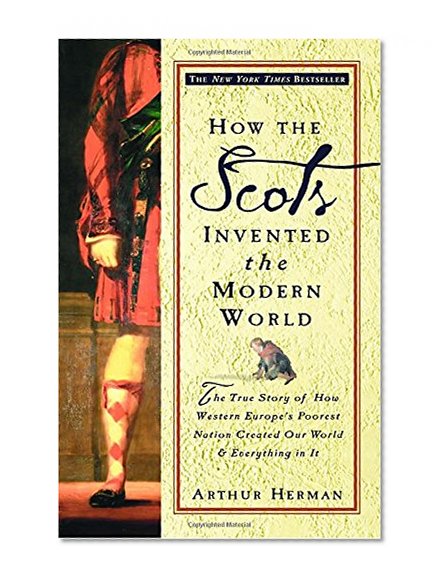
How the Scots Invented the Modern World: The True Story of How Western Europe's Poorest Nation Created Our World & Everything in It

Author Arthur Herman
Publisher Broadway Books
Category History
📄 Viewing lite version Full site ›
🌎 Shop on Amazon — choose country
11.32 17.00 USD
🛒 Buy New on Amazon 🇺🇸 🏷 Buy Used — $1.51

✓ Usually ships in 24 hours

Share:
Book Details
Author(s)Arthur Herman
ISBN / ASIN0609809997
ISBN-139780609809990
AvailabilityUsually ships in 24 hours
Sales Rank21,339
CategoryHistory
MarketplaceUnited States 🇺🇸

Description

"I am a Scotsman," Sir Walter Scott famously wrote, "therefore I had to fight my way into the world." So did any number of his compatriots over a period of just a few centuries, leaving their native country and traveling to every continent, carving out livelihoods and bringing ideas of freedom, self-reliance, moral discipline, and technological mastery with them, among other key assumptions of what historian Arthur Herman calls the "Scottish mentality."

It is only natural, Herman suggests, that a country that once ranked among Europe's poorest, if most literate, would prize the ideal of progress, measured "by how far we have come from where we once were." Forged in the Scottish Enlightenment, that ideal would inform the political theories of Francis Hutcheson, Adam Smith, and David Hume, and other Scottish thinkers who viewed "man as a product of history," and whose collective enterprise involved "nothing less than a massive reordering of human knowledge" (yielding, among other things, the Encyclopaedia Britannica, first published in Edinburgh in 1768, and the Declaration of Independence, published in Philadelphia just a few years later). On a more immediately practical front, but no less bound to that notion of progress, Scotland also fielded inventors, warriors, administrators, and diplomats such as Alexander Graham Bell, Andrew Carnegie, Simon MacTavish, and Charles James Napier, who created empires and great fortunes, extending Scotland's reach into every corner of the world.

Herman examines the lives and work of these and many more eminent Scots, capably defending his thesis and arguing, with both skill and good cheer, that the Scots "have by and large made the world a better place rather than a worse place." --Gregory McNamee

Dark Sun: The Making of the Hydrogen Bomb
View
Cinema and Development in West Africa
View
The Blitzkrieg Myth: How Hitler and the Allies Misread…
View
The Color of Citizenship: Race, Modernity and Latin Am…
View
The Oxford Handbook of Percy Bysshe Shelley
View
Mexico's Unrule of Law: Implementing Human Rights in P…
View
African Migrations: Patterns and Perspectives
View
The Return of George Washington: 1783-1789
View