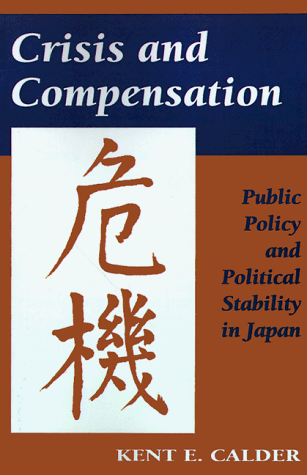
Why does Japan, with its efficiency-oriented technocracy, periodically adopt welfare-oriented, economically inefficient domestic policies? In answering this question Kent Calder shows that Japanese policymakers respond to threats to the ruling party's preeminence by extending income compensation, entitlements, and subsidies, with market-oriented retrenchment coming as crisis subsides. "Quite simply the most ambitious and strongly argued interpretation of a key dimension of Japanese political life to appear in English this decade."--David Williams, Japan Times "Historically dense and conceptually rich.... [Forces] readers' attention to the domestic underpinnings of Japanese foreign policy."--Donald S. Zagoria, Foreign Affairs "Punctures the myth of Japan Inc. as a cool, rational monolith...."--Kathleen Newland, Millennium "A bold reinterpretation of Japanese politics that will force us to rethink many of our current assumptions and will influence our research agenda."--Steven R. Reed, Journal of Japanese Studies
Crisis and Compensation
📄 Viewing lite version
Full site ›
Book Details
Author(s)Kent E. Calder
PublisherPrinceton University Press
ISBN / ASIN0691023387
ISBN-139780691023380
AvailabilityUsually ships in 24 hours
Sales Rank2,807,257
MarketplaceUnited States 🇺🇸