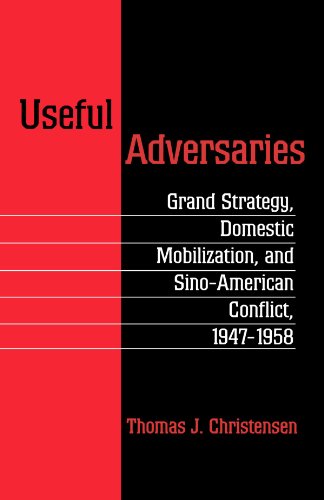
This book provides a new analysis of why relations between the United States and the Chinese Communists were so hostile in the first decade of the Cold War. Employing extensive documentation, it offers a fresh approach to long-debated questions such as why Truman refused to recognize the Chinese Communists, why the United States aided Chiang Kai-shek's KMT on Taiwan, why the Korean War escalated into a Sino-American conflict, and why Mao shelled islands in the Taiwan Straits in 1958, thus sparking a major crisis with the United States.
Christensen first develops a novel two-level approach that explains why leaders manipulate low-level conflicts to mobilize popular support for expensive, long-term security strategies. By linking "grand strategy," domestic politics, and the manipulation of ideology and conflict, Christensen provides a nuanced and sophisticated link between domestic politics and foreign policy. He then applies the approach to Truman's policy toward the Chinese Communists in 1947-50 and to Mao's initiation of the 1958 Taiwan Straits Crisis. In these cases the extension of short-term conflict was useful in gaining popular support for the overall grand strategy that each leader was promoting domestically: Truman's limited-containment strategy toward the USSR and Mao's self-strengthening programs during the Great Leap Forward. Christensen also explores how such low-level conflicts can escalate, as they did in Korea, despite leaders' desire to avoid actual warfare.