Why do some democratic governments succeed and others fail? In a book that has received attention from policymakers and civic activists in America and around the world, Robert Putnam and his collaborators offer empirical evidence for the importance of "civic community" in developing successful institutions. Their focus is on a unique experiment begun in 1970 when Italy created new governments for each of its regions. After spending two decades analyzing the efficacy of these governments in such fields as agriculture, housing, and health services, they reveal patterns of associationism, trust, and cooperation that facilitate good governance and economic prosperity.
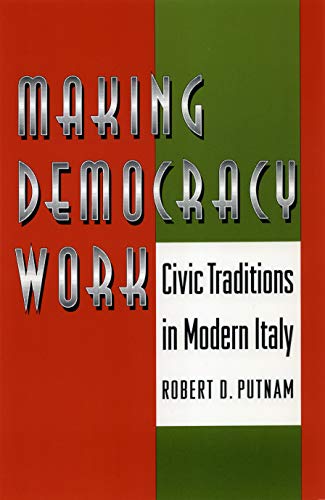
Making Democracy Work: Civic Traditions in Modern Italy
📄 Viewing lite version
Full site ›
⌛ 🇫🇷 France pricing being fetched…
Prices will appear once fetched — usually within a few minutes.
View in:
🇺🇸 USA
Book Details
Author(s)Putnam, Robert D.
PublisherPrinceton University Press
ISBN / ASIN0691037388
ISBN-139780691037387
CategoryPolitical Science
MarketplaceFrance 🇫🇷
Description ▲
More Books in Political Science
The Millennium Development Goals and Beyond: Internati…
View
Transnational Networks in Regional Integration: Govern…
View
Forensic Psychophysiology Using the Polygraph: Scienti…
View
Gender, Islam and Democracy in Indonesia (ASAA Women i…
View
E-Governance: A Change Management Tool
View
Shop Floor Bargaining and the State: Historical and Co…
View
Red State Uprising: How to Take Back America
View
A Community Health Approach to the Assessment of Infan…
View
Foreign Aid and Landmine Clearance: Governance, Politi…
View