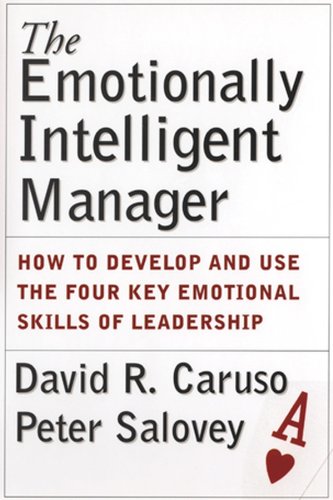
The Emotionally Intelligent Manager: How to Develop and Use the Four Key Emotional Skills of Leadership
📄 Viewing lite version
Full site ›
Book Details
Author(s)Caruso, David R.
PublisherJossey-Bass
ISBN / ASIN0787970719
ISBN-139780787970710
AvailabilityIn Stock.
Sales Rank386,162
CategoryBusiness & Economics
MarketplaceUnited States 🇺🇸
Description ▲
We have long been taught that emotions should be felt and expressed in carefully controlled ways, and then only in certain environments and at certain times. This is especially true when at work, particularly when managing others. It is considered terribly unprofessional to express emotion while on the job, and many of us believe that our biggest mistakes and regrets are due to our reactions at those times when our emotions get the better of us. David R. Caruso and Peter Salovey believe that this view of emotion is not correct. The emotion centers of the brain, they argue, are not relegated to a secondary place in our thinking and reasoning, but instead are an integral part of what it means to think, reason, and to be intelligent. In The Emotionally Intelligent Manager, they show that emotion is not just important, but absolutely necessary for us to make good decisions, take action to solve problems, cope with change, and succeed. The authors detail a practical four-part hierarchy of emotional skills: identifying emotions, using emotions to facilitate thinking, understanding emotions, and managing emotions—and show how we can measure, learn, and develop each skill and employ them in an integrated way to solve our most difficult work-related problems.
More Books in Business & Economics
Culture and Business in Asia
View
How to Raise Goats: Everything You Need to Know, Updat…
View
How To Set Up and Maintain a BETTER Voiceover Business…
View
Data Warehousing and Knowledge Discovery: 8th Internat…
View
The Dixification of America: The American Odyssey into…
View
Cash Flow Strategies: Learn to start a business and ma…
View
Las lecturas diarias de Maxwell (Spanish Edition)
View
Traderevolution: Training for Traders
View