Search Books
Introduction to Graph Theor… Design of Experiments: An I…

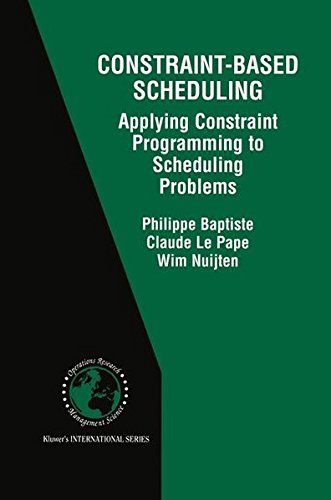
Constraint-Based Scheduling: Applying Constraint Programming to Scheduling Problems (International Series in Operations Research & Management Science)

Author Philippe Baptiste, Claude Le Pape, Wim Nuijten
Publisher Springer
Category Mathematics
📄 Viewing lite version Full site ›
🌎 Shop on Amazon — choose country
⌛ 🇬🇧 United Kingdom pricing being fetched… Prices will appear once fetched — usually within a few minutes.
Share:
Book Details
PublisherSpringer
ISBN / ASIN0792374088
ISBN-139780792374084
CategoryMathematics
MarketplaceUnited Kingdom 🇬🇧

Description

Constraint Programming is a problem-solving paradigm that establishes a clear distinction between two pivotal aspects of a problem: (1) a precise definition of the constraints that define the problem to be solved and (2) the algorithms and heuristics enabling the selection of decisions to solve the problem.
It is because of these capabilities that Constraint Programming is increasingly being employed as a problem-solving tool to solve scheduling problems. Hence the development of Constraint-Based Scheduling as a field of study.
The aim of this book is to provide an overview of the most widely used Constraint-Based Scheduling techniques. Following the principles of Constraint Programming, the book consists of three distinct parts:
  • The first chapter introduces the basic principles of Constraint Programming and provides a model of the constraints that are the most often encountered in scheduling problems.
  • Chapters 2, 3, 4, and 5 are focused on the propagation of resource constraints, which usually are responsible for the "hardness" of the scheduling problem.
  • Chapters 6, 7, and 8 are dedicated to the resolution of several scheduling problems. These examples illustrate the use and the practical efficiency of the constraint propagation methods of the previous chapters. They also show that besides constraint propagation, the exploration of the search space must be carefully designed, taking into account specific properties of the considered problem (e.g., dominance relations, symmetries, possible use of decomposition rules).
Chapter 9 mentions various extensions of the model and presents promising research directions.
Topics in Finite and Discrete Mathematics
View
Applications of Mathematics in Engineering and Economi…
View
Linear Algebra Supplement to Accompany Calculus with A…
View
Random Matrix Models and their Applications (Mathemati…
View
Continuous Crossed Products and Type III Von Neumann A…
View
First European Congress of Mathematics Paris, July 6-1…
View
Workshop Statistics: Discovery with Data, JMP Companio…
View
XXVI International Workshop on Geometrical Methods in …
View
Social Policy Reform in Hong Kong and Shanghai: A Tale…
View