Foundations of Dependable Computing: Models and Frameworks forDependable Systems presents two comprehensive frameworks for reasoning about system dependability, thereby establishing a context for understanding the roles played by specific approaches presented in this book's two companion volumes. It then explores the range of models and analysis methods necessary to design, validate and analyze dependable systems.
A companion to this book (published by Kluwer), subtitled Paradigmsfor Dependable Applications, presents a variety of specific approaches to achieving dependability at the application level. Driven by the higher level fault models of Models and Frameworks for DependableSystems, and built on the lower level abstractions implemented in a third companion book subtitled System Implementation, these approaches demonstrate how dependability may be tuned to the requirements of an application, the fault environment, and the characteristics of the target platform. Three classes of paradigms are considered: protocol-based paradigms for distributed applications, algorithm-based paradigms for parallel applications, and approaches to exploiting application semantics in embedded real-time control systems.
Another companion book (published by Kluwer) subtitled SystemImplementation, explores the system infrastructure needed to support the various paradigms of Paradigms for Dependable Applications. Approaches to implementing support mechanisms and to incorporating additional appropriate levels of fault detection and fault tolerance at the processor, network, and operating system level are presented. A primary concern at these levels is balancing cost and performance against coverage and overall dependability. As these chapters demonstrate, low overhead, practical solutions are attainable and not necessarily incompatible with performance considerations. The section on innovative compiler support, in particular, demonstrates how the benefits of application specificity may be obtained while reducing hardware cost and run-time overhead.
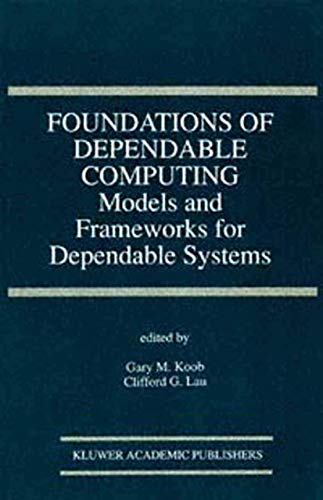
Foundations of Dependable Computing: Models and Frameworks for Dependable Systems (The Springer International Series in Engineering and Computer Science)
📄 Viewing lite version
Full site ›
Book Details
PublisherSpringer
ISBN / ASIN0792394844
ISBN-139780792394846
AvailabilityUsually ships in 24 hours
Sales Rank6,375,414
CategoryComputers
MarketplaceUnited States 🇺🇸
Description ▲
More Books in Computers
Windows XP, Vol. 1 (SELECT Series)
View
Internet Searching and Indexing: The Subject Approach
View
Control Problems in Industry: Proceedings from the SIA…
View
Open Source Systems Security Certification
View
Java: Data Structures and Programming
View
User-Centered Web Development
View
Query Processing in Database Systems (Topics in Inform…
View
Fundamentals of SQL Server 2005
View
Dreamweaver CS4: The Missing Manual (Spanish Edition)
View