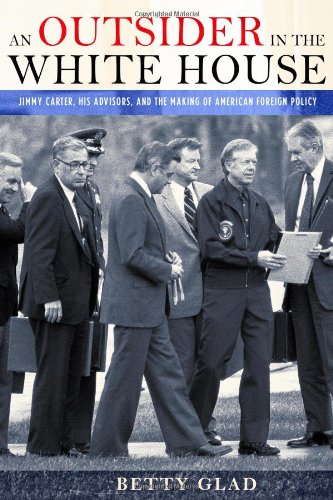
Jimmy Carter entered the White House with a desire for a collegial staff that would aid his foreign-policy decision making. He wound up with a "team of rivals" who contended for influence and who fought over his every move regarding relations with the USSR, the Peoples' Republic of China, arms control, and other crucial foreign-policy issues.
In two areas—the Camp David Accords and the return of the Canal to Panama—Carter's successes were attributable to his particular political skills and the assistance of Secretary of State Cyrus Vance and other professional diplomats. The ultimate victor in the other battles was Carter's national security advisor, Zbigniew Brzezinski, a motivated tactician. Carter, the outsider who had sought to change the political culture of the executive office, found himself dependent on the very insiders of the political and diplomatic establishment against whom he had campaigned.
Based on recently declassified documents in the Carter Library, materials not previously noted in the Vance papers, and a wide variety of interviews, Betty Glad's An Outsider in the White House is a rich and nuanced depiction of the relationship between policy and character. It is also a poignant history of damaged ideals. Carter's absolute commitment to human rights foundered on what were seen as national security interests.
New data from the archives reveal how Carter's government sought the aid of Pope John Paul II to undercut the human-rights efforts of the El Salvadoran Archbishop Oscar Romero. A moralistic approach toward the Soviet Union undermined Carter's early desire to reduce East-West conflicts and cut nuclear arms. As a result, by 1980 the Strategic Arms Limitation Treaty (SALT) was in limbo, and a nuclear counterforce doctrine had been adopted.
Near the end of Carter's single term in office Vance stepped down as secretary of state, in part because Brzezinski's "muscular diplomacy" had come to dominate Carter's foreign policy. When Vance's successor, Edmund Muskie, took over, the State Department was reduced to implementing policies made by Brzezinski and his allies. For Carter, the rivalry for influence in the White House was concluded and the results, as Glad shows, were a mixed record and an uncertain presidential legacy.