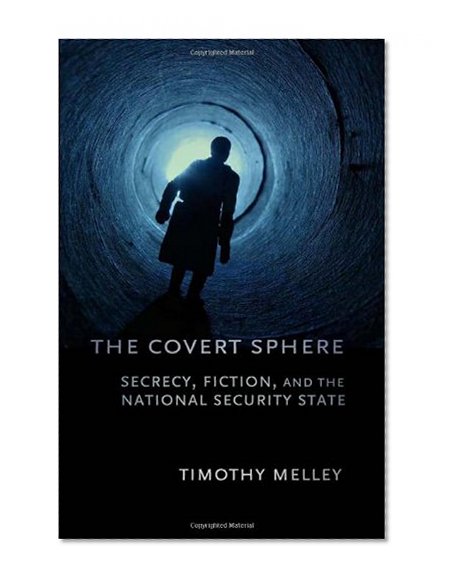
In December 2010 the U.S. Embassy in Kabul acknowledged that it was providing major funding for thirteen episodes of Eagle Four―a new Afghani television melodrama based loosely on the blockbuster U.S. series 24. According to an embassy spokesperson, Eagle Four was part of a strategy aimed at transforming public suspicion of security forces into something like awed respect. Why would a wartime government spend valuable resources on a melodrama of covert operations? The answer, according to Timothy Melley, is not simply that fiction has real political effects but that, since the Cold War, fiction has become integral to the growth of national security as a concept and a transformation of democracy.
In The Covert Sphere, Melley links this cultural shift to the birth of the national security state in 1947. As the United States developed a vast infrastructure of clandestine organizations, it shielded policy from the public sphere and gave rise to a new cultural imaginary, "the covert sphere." One of the surprising consequences of state secrecy is that citizens must rely substantially on fiction to "know," or imagine, their nation's foreign policy. The potent combination of institutional secrecy and public fascination with the secret work of the state was instrumental in fostering the culture of suspicion and uncertainty that has plagued American society ever since―and, Melley argues, that would eventually find its fullest expression in postmodernism.
The Covert Sphere traces these consequences from the Korean War through the War on Terror, examining how a regime of psychological operations and covert action has made the conflation of reality and fiction a central feature of both U.S. foreign policy and American culture. Melley interweaves Cold War history with political theory and original readings of films, television dramas, and popular entertainments―from The Manchurian Candidate through 24―as well as influential writing by Margaret Atwood, Robert Coover, Don DeLillo, Joan Didion, E. L. Doctorow, Michael Herr, Denis Johnson, Norman Mailer, Tim O'Brien, and many others.