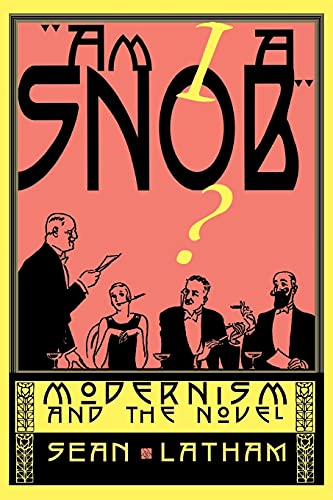
Am I a Snob?: Modernism and the Novel
📄 Viewing lite version
Full site ›
Book Details
Author(s)Sean Latham
PublisherCornell University Press
ISBN / ASIN0801488419
ISBN-139780801488412
AvailabilityUsually ships in 24 hours
Sales Rank1,345,559
CategoryPaperback
MarketplaceUnited States 🇺🇸
Description ▲
Is there a "great divide" between highbrow and mass cultures? Are modernist novels for, by, and about snobs? What might Lord Peter Wimsey, Mrs. Dalloway, and Stephen Dedalus have to say to one another?Sean Latham's appealingly written book "Am I a Snob?" traces the evolution of the figure of the snob through the works of William Makepeace Thackeray, Oscar Wilde, Virginia Woolf, James Joyce, and Dorothy Sayers. Each of these writers played a distinctive role in the transformation of the literary snob from a vulgar social climber into a master of taste. In the process, some novelists and their works became emblems of sophistication, treated as if they were somehow apart from or above the fiction of the popular marketplace, while others found a popular audience. Latham argues that both coterie writers like Joyce and popular novelists like Sayers struggled desperately to combat their own pretensions. By portraying snobs in their novels, they attempted to critique and even transform the cultural and economic institutions that they felt isolated them from the broad readership they desired.Latham regards the snobbery that emerged from and still clings to modernism not as an unfortunate by-product of aesthetic innovation, but as an ongoing problem of cultural production. Drawing on the tools and insights of literary sociology and cultural studies, he traces the nineteenth-century origins of the "snob," then explores the ways in which modernist authors developed their own snobbery as a means of coming to critical consciousness regarding the connections among social, economic, and cultural capital. The result, Latham asserts, is a modernism directly engaged with the cultural marketplace yet deeply conflicted about the terms of its success.
More Books in Paperback
Nightmare Hour TV Tie-in Edition
View
First Light
View
The Miles Between
View
Prize Stories 1990: The O. Henry Awards (Pen / O. Henr…
View
Democracy Begins Between Two
View
The Model Locomotive Engineer, Fireman, and Engine Boy
View
Bloodline in the Sand
View
Making America, Volume A, Brief, 2nd Ed + Perfect Unio…
View
Ellis, Becoming a Master Student, 11th Edition Plus My…
View