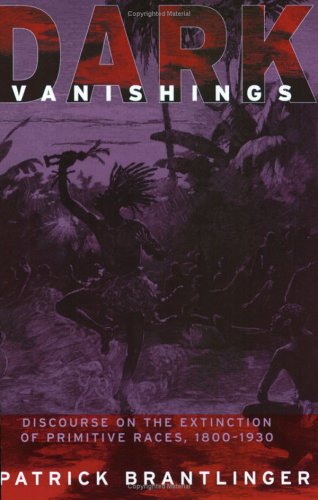
Patrick Brantlinger here examines the commonly held nineteenth-century view that all "primitive" or "savage" races around the world were doomed sooner or later to extinction. Warlike propensities and presumed cannibalism were regarded as simultaneously noble and suicidal, accelerants of the downfall of other races after contact with white civilization. Brantlinger finds at the heart of this belief the stereotype of the self-exterminating savage, or the view that "savagery" is a sufficient explanation for the ultimate disappearance of "savages" from the grand theater of world history.
Humanitarians, according to Brantlinger, saw the problem in the same terms of inevitability (or doom) as did scientists such as Charles Darwin and Thomas Henry Huxley as well as propagandists for empire such as Charles Wentworth Dilke and James Anthony Froude. Brantlinger analyzes the Irish Famine in the context of ideas and theories about primitive races in North America, Australia, New Zealand, and elsewhere. He shows that by the end of the nineteenth century, especially through the influence of the eugenics movement, extinction discourse was ironically applied to "the great white race" in various apocalyptic formulations. With the rise of fascism and Nazism, and with the gradual renewal of aboriginal populations in some parts of the world, by the 1930s the stereotypic idea of "fatal impact" began to unravel, as did also various more general forms of race-based thinking and of social Darwinism.