Search Books
Global Communications since… Transforming Matter: A Hist…

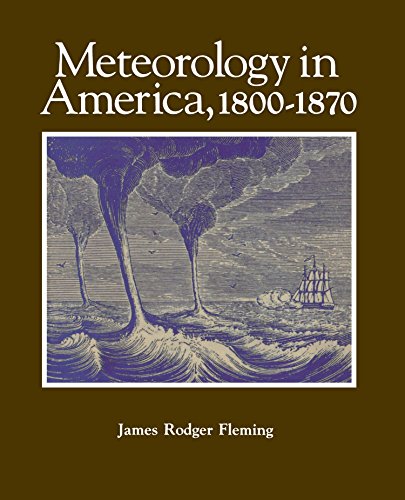
Meteorology in America, 1800-1870

Author James Rodger Fleming
Publisher Johns Hopkins University Press
Category Science
📄 Viewing lite version Full site ›
🌎 Shop on Amazon — choose country
24.16 27.00 USD
🛒 Buy New on Amazon 🇺🇸 🏷 Buy Used — $20.16

✓ Usually ships in 24 hours

Share:
Book Details
ISBN / ASIN0801863597
ISBN-139780801863592
AvailabilityUsually ships in 24 hours
Sales Rank206,954
CategoryScience
MarketplaceUnited States 🇺🇸

Description

Between 1800 and 1870 meteorology emerged as both a legitimate science and a government service in America. Challenging the widely held assumption that meteorologists were mere "data-gatherers" and that U.S. scientists were inferior to their European counterparts, James Rodger Fleming shows how the 1840s debate over the nature and causes of storms led to a "meteorological crusade" that would transform both theory and practice. Centrally located administrators organized hundreds of widely dispersed volunteer and military observers into systematic projects that covered the entire nation. Theorists then used these systems to "observe" weather patterns over large areas, making possible for the first time the compilation of accurate weather charts and maps.

When in 1870 Congress created a federal storm-warning service under the U.S. Army Signal Office, the era of amateur scientists, volunteer observers, and adhoc organizations came to an end. But the gains had been significant, including advances in natural history and medical geography, and in understanding the general circulation of the earth's atmosphere.

Student Study Guide to accompany Physics, 10e
View
Classical and Statistical Thermodynamics
View
Microbial Ecology of the Oceans (Wiley Series in Ecolo…
View
The Harvey Lectures 2004-2005
View
Medical Device Technologies: A Systems Based Overview …
View
Hydraulic Fracturing and Shale Gas Production: Issues,…
View
Immunocytochemistry: A Practical Guide for Biomedical …
View
Titanium Dioxide: Applications, Synthesis and Toxicity…
View