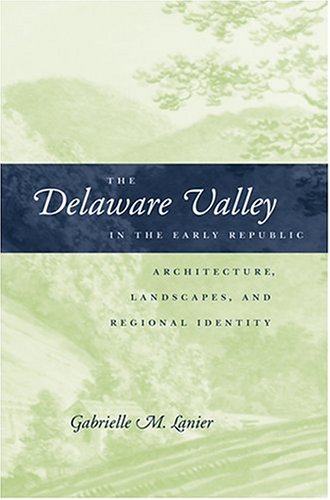
"History, after all, has a corporeal aspect—every event occupies a physical dimension, and all actions are ultimately grounded, one way or another, in the landscape. Places, which possess their own geography, natural history, and embedded perceptions, not only ground the physicality of historical events—they also can constitute both actor and stage."—from The Delaware Valley in the Early Republic. The Delaware Valley's role in shaping national identity during the formative years of the early American republic has long been overshadowed by New England and the South, both more readily identified as distinct and coherent regions than the broad geographic swath that includes Delaware, southwestern New Jersey, and southeastern Pennsylvania. For architectural historians, geographers, and folklorists, the Delaware River valley offers a fascinating example of a true cultural crossroads. Comprising several distinctive and intensely local subregions—each with its own building traditions, populations, land use patterns, and material cultures—this "region of regions" provides rich insights into late eighteenth- and early nineteenth-century America.
Gabrielle Lanier challenges prevailing characterizations of the region as culturally monolithic and reassesses its role in the formation of a distinctly American identity through the history, geography, and architecture of three of the valley's diverse cultural landscapes: Pennsylvania's predominantly Germanic Warwick Township; New Jersey's Mannington Township, settled by English Quakers; and Delaware's North West Fork Hundred, an area strongly influenced by its proximity to the Chesapeake region and its position between the slave South and the free North.
Through narratives of individual lives, aggregate data from tax rolls and censuses, archival research, and close analysis of the built vernacular environment, she examines the unique ethnic, class, and religious constitution of each subregion, as well as its racial diversity, political orientation, economic organization, and cultural imprint on the landscape. The Delaware Valley emerges from this boldly interdisciplinary study as a mosaic of localities that reflects underlying tensions in the American experience.
(2005)