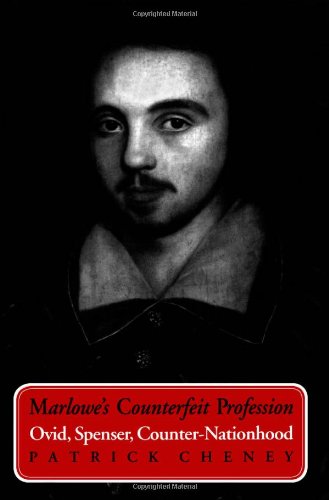
Marlowe's Counterfeit Profession presents the first comprehensive reading of the Marlowe canon in over a generation. The occasion for Patrick Cheney's rereading is a primary discovery: Marlowe organized his canon around an "Ovidian" career model, or cursus, which turns from amatory poetry to tragedy to epic. Ovid had advertised this cursus only in his inaugural poem, the Amores, where its purpose was to counter the Virgilian cursus of pastoral, georgic, and epic. Marlowe was the first writer to translate the Amores, and thus the first to make the Ovidian cursus literally his own.
Marlowe inscribes this cursus not simply to participate in the Renaissance recovery of classical authors, but in particular to contest the national authority of the 'Virgil of England,' Edmund Spenser. Using an Ovidian cursus to contest Spenser's Virgilian cursus, Marlowe enters the generational project of writing English nationhood. Unlike Spenser, however, Marlowe writes a 'counter-nationhood' - a nonpatriotic form of nationhood that subverts royal power with what Ovid calls libertas.
By discovering the original project organizing an otherwise fragmentary canon, Cheney aims to change the most basic lens through which critics have viewed Marlowe: 'Shakespearean drama'. This lens cannot account for two of the most striking features of Marlowe's canon: his scholarly use of translation and his writing of epic. Cheney proposes that a theatrical, Shakespearean model has prevented critics from discovering the original context within which Marlowe produced his art: a multimedia, multi-genre Spenserian model of Ovidian counter-nationhood.