One of the greatest, as well as the most debated, social policy ideas of the 1980s and 1990s was workfare. In Workfare: Why Good Social Policy Ideas Go Bad, Maeve Quaid delves into the definition and history of workfare, and then continues with a critical and comparative analysis of workfare programs in six jurisdictions: three American (California, Wisconsin, New York) and three Canadian (Alberta, Ontario, New Brunswick). Drawing from these case studies, Quaid develops an analytic model that illustrates how workfare falls prey to a series of hazards whereby good social policy ideas fail. Their demise, argues Quaid, begins with politicians with a zest for big ideas but little interest in implementation, continues with short-sighted policy makers, resistant bureaucrats, cynical recipients, flawed evaluations, and is completed by fleeting and fickle public attention for these news stories. Quaid's identification and analysis of these hazards is especially valuable because the hazards can also be applied to innovation in any area of social policy, such as health-care, education, pension plans, child-care, and unemployment insurance.
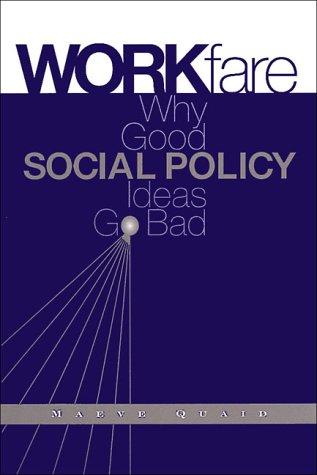
Workfare: Why Good Social Policy Ideas Go Bad
📄 Viewing lite version
Full site ›
Book Details
Author(s)Maeve Quaid
ISBN / ASIN0802081010
ISBN-139780802081018
AvailabilityUsually ships in 24 hours
Sales Rank5,564,827
CategoryPolitical Science
MarketplaceUnited States 🇺🇸
Description ▲
More Books in Political Science
The Millennium Development Goals and Beyond: Internati…
View
Transnational Networks in Regional Integration: Govern…
View
Forensic Psychophysiology Using the Polygraph: Scienti…
View
Gender, Islam and Democracy in Indonesia (ASAA Women i…
View
E-Governance: A Change Management Tool
View
Shop Floor Bargaining and the State: Historical and Co…
View
Red State Uprising: How to Take Back America
View
A Community Health Approach to the Assessment of Infan…
View
Foreign Aid and Landmine Clearance: Governance, Politi…
View
The Limits of Culture: Islam and Foreign Policy (Belfe…
View