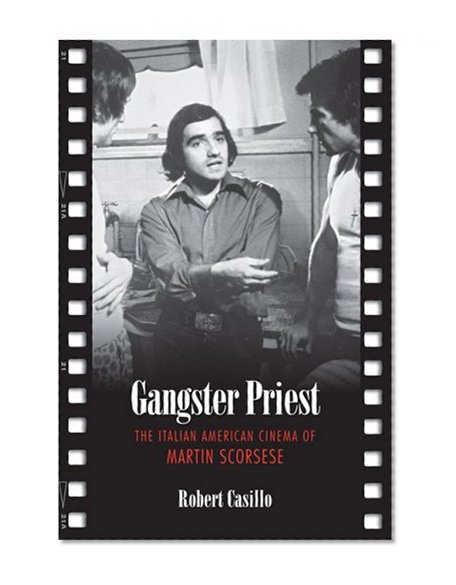
Widely acclaimed as America's greatest living film director, Martin Scorsese is also, some argue, the pre-eminent Italian American artist. Although he has treated various subjects in over three decades, his most sustained filmmaking and the core of his achievement consists of five films on Italian American subjects - Who's That Knocking at My Door?, Mean Streets, Raging Bull, GoodFellas, and Casino - as well as the documentary Italianamerican. In Gangster Priest Robert Casillo examines these films in the context of the society, religion, culture, and history of Southern Italy, from which the majority of Italian Americans, including Scorsese, derive.
Casillo argues that these films cannot be fully appreciated either thematically or formally without understanding the various facets of Italian American ethnicity, as well as the nature of Italian American cinema and the difficulties facing assimilating third-generation artists. Forming a unified whole, Scorsese's Italian American films offer what Casillo views as a prolonged meditation on the immigrant experience, the relationship between Italian America and Southern Italy, the conflicts between the ethnic generations, and the formation and development of Italian American ethnicity (and thus identity) on American soil through the generations. Raised as a Catholic and deeply imbued with Catholic values, Scorsese also deals with certain forms of Southern Italian vernacular religion, which have left their imprint not only on Scorsese himself but also on the spiritually tormented characters of his Italian American films. Casillo also shows how Scorsese interrogates the Southern Italian code of masculine honour in his exploration of the Italian American underworld or Mafia, and through his implicitly Catholic optic, discloses its thoroughgoing and longstanding opposition to Christianity.
Bringing a wealth of scholarship and insight into Scorsese's work, Casillo's study will captivate readers interested in the director's magisterial artistry, the rich social history of Southern Italy, Italian American ethnicity, and the sociology and history of the Mafia in both Sicily and the United States.