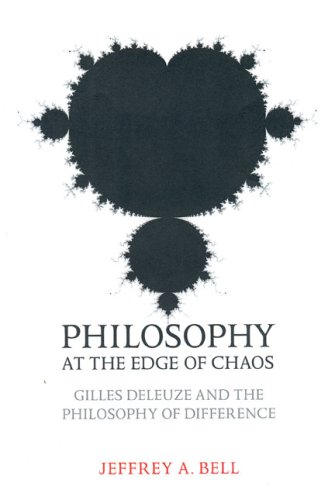
From the early 1960s until his death, French philosopher Gilles Deleuze (1925-1995) wrote many influential works on philosophy, literature, film, and fine art. One of Deleuze's main philosophical projects was a systematic inversion of the traditional relationship between identity and difference. This Deleuzian philosophy of difference is the subject of Jeffrey A. Bell's Philosophy at the Edge of Chaos.
Bell argues that Deleuze's efforts to develop a philosophy of difference are best understood by exploring both Deleuze's claim to be a Spinozist, and Nietzsche's claim to have found in Spinoza an important precursor. Beginning with an analysis of these claims, Bell shows how Deleuze extends and transforms concepts at work in Spinoza and Nietzsche to produce a philosophy of difference that promotes and, in fact, exemplifies the notions of dynamic systems and complexity theory. With these concepts at work, Deleuze constructs a philosophical approach that avoids many of the difficulties that linger in other attempts to think about difference. Bell uses close readings of Plato, Aristotle, Spinoza, Nietzsche, Heidegger, Derrida, and Whitehead to illustrate how Deleuze's philosophy is successful in this regard and to demonstrate the importance of the historical tradition for Deleuze. Far from being a philosopher who turns his back on what is taken to be a mistaken metaphysical tradition, Bell argues that Deleuze is best understood as a thinker who endeavoured to continue the work of traditional metaphysics and philosophy.