Search Books
The Original Bulldog Drummo… Las Cinco Personas Que Enco…

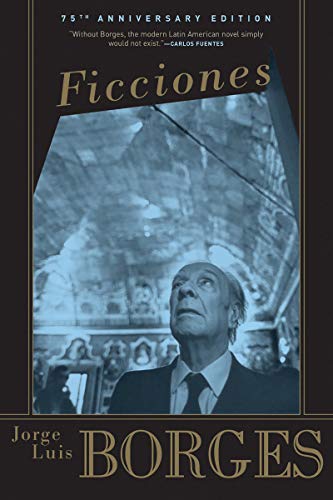
Ficciones

Author Borges, Jorge Luis
Publisher Grove Press
Category Fiction
📄 Viewing lite version Full site ›
🌎 Shop on Amazon — choose country
11.74 18.00 USD
🛒 Buy New on Amazon 🇺🇸

✓ In Stock

Share:
Book Details
PublisherGrove Press
ISBN / ASIN0802130305
ISBN-139780802130303
AvailabilityIn Stock
CategoryFiction
MarketplaceUnited States 🇺🇸

Description

Reading Jorge Luis Borges is an experience akin to having the top of one's head removed for repairs. First comes the unfamiliar breeze tickling your cerebral cortex; then disorientation, even mild discomfort; and finally, the sense that the world has been irrevocably altered--and in this case, rendered infinitely more complex. First published in 1945, his Ficciones compressed several centuries' worth of philosophy and poetry into 17 tiny, unclassifiable pieces of prose. He offered up diabolical tigers, imaginary encyclopedias, ontological detective stories, and scholarly commentaries on nonexistent books, and in the process exploded all previous notions of genre. Would any of David Foster Wallace's famous footnotes be possible without Borges? Or, for that matter, the syntactical games of Perec, the metafictional pastiche of Calvino? For good or for ill, the blind Argentinian paved the way for a generation's worth of postmodern monkey business--and fiction will never be simply "fiction" again.

Its enormous influence on writers aside, Ficciones has also--perhaps more importantly--changed the way that we read. Borges's Pierre Menard, for instance, undertakes the most audacious project imaginable: to create not a contemporary version of Cervantes's most famous work but the Quixote itself, word for word. This second text is "verbally identical" to the original, yet, because of its new associations, "infinitely richer"; every time we read, he suggests, we are in effect creating an entirely new text, simply by viewing it through the distorting lens of history. "A book is not an isolated being: it is a relationship, an axis of innumerable relationships," Borges once wrote in an essay about George Bernard Shaw. "All men who repeat one line of Shakespeare are William Shakespeare," he tells us in "Tlön, Uqbar, Orbis Tertius." In this spirit, Borges is not above impersonating, even quoting, himself.

It is hard, exactly, to say what all of this means, at least in any of the usual ways. Borges wrote not with an ideological agenda, but with a kind of radical philosophical playfulness. Labyrinths, libraries, lotteries, doubles, dreams, mirrors, heresiarchs: these are the tokens with which he plays his ontological games. In the end, ideas themselves are less important to him than their aesthetic and imaginative possibilities. Like the idealist philosophers of Tlön, Borges does not "seek for the truth or even for verisimilitude, but rather for the astounding"; for him as for them, "metaphysics is a branch of fantastic literature." --Mary Park

Similar Products

Pale Demon (The Hollows, Book 9)
View
Lost Bodies: A Novel
View
Prize Stories 1991: The O. Henry Awards (Pen / O. Henr…
View
Testing Kate
View
The Magazine of Unbelievable Stories (April 2007) Glob…
View
The Exodus Gate
View
Blood Trust (Jack McClure-Alli Carson Novels)
View
Earthbound
View
Hex: A Ruby Murphy Mystery (Ruby Murphy Mysteries)
View