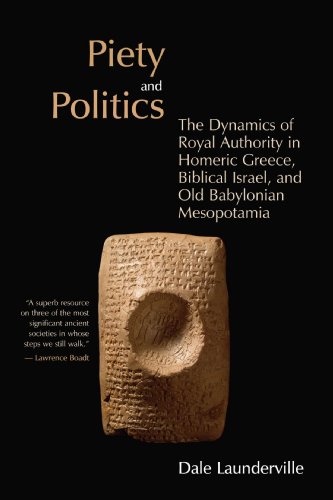
Piety and Politics: The Dynamics of Royal Authority in Homeric Greece, Biblical Israel, and Old Babylonian Mesopotamia (Bible in Its World)
📄 Viewing lite version
Full site ›
Book Details
Author(s)Mr. Dale Launderville
PublisherWm. B. Eerdmans Publishing Co.
ISBN / ASIN0802845053
ISBN-139780802845054
AvailabilityUsually ships in 24 hours
Sales Rank3,972,180
CategoryReligion
MarketplaceUnited States 🇺🇸
Description ▲
Ancient kings who did not honor the gods overlooked an indispensable means for ruling effectively in their communities. In many traditional societies royal authority was regarded as a divine gift bestowed according to the quality of the relationship of the king both to God or the gods and to the people. The tension and the harmony within these human and divine relationships demanded that the king repeatedly strive to integrate the community's piety with his political strategies. This fascinating study explores the relationship between religion and royal authority in three of history's most influential civilizations: Homeric Greece, biblical Israel, and Old Babylonian Mesopotamia. Dale Launderville identifies similar, contrasting, and analogous ways that piety functioned in these distinct cultures to legitimate the rule of particular kings and promote community well-being. Key to this religiopolitical dynamic was the use of royal rhetoric, which necessarily took the form of political theology. By examining a host of ancient texts and drawing on the insights of philosophers, poets, historians, anthropologists, social theorists, and theologians, Launderville shows how kings increased their status the more they demonstrated through their speech and actions that they ruled on behalf of God or the gods. Launderville's work also sheds light on a number of perennial questions about ancient political life. How could the people call the king to account? Did the people forfeit too much of their freedom and initiative by giving obedience to a king who symbolized their unity as a community? How did the religious traditions serve as a check on the king's power and keep alive the voice of the people? This study in comparative political theology elucidates these engaging concerns from multiple perspectives, making Piety and Politics of interest to readers in fields ranging from biblical studies and theology to ancient history and
More Books in Religion
No Wonder They Call Him the Savior: Discover Hope In T…
View
Great Lives: David: A Man of Passion and Destiny (Disc…
View
Love Does: Discover a Secretly Incredible Life in an O…
View
So Close to Heaven: The Vanishing Buddhist Kingdoms of…
View
Economia neotestamentaria de Dios, La
View
Paul and the Second Century (The Library of New Testam…
View
Women Who Hear Voices (2003 Madeleva Lecture in Spirit…
View
My Cup of Blessing: A Nurtured Spiritual Life Reaches …
View