In the twelve analytical essays in Studies in British Military Thought Brian Holden Reid examines these two figures whose ideas have influenced the interpretation of events in military history from antiquity to the Cold War. He compares and contrasts their views on tactics, operational art and strategy, and war as a social phenomenon. Additionally, he discusses the radically different temperaments of the two and shows how their differences shaped their work in important ways. In so doing, he continues to bring their ideas to students and practitioners of modern warfare and raises fundamental issues concerning the nature of war.
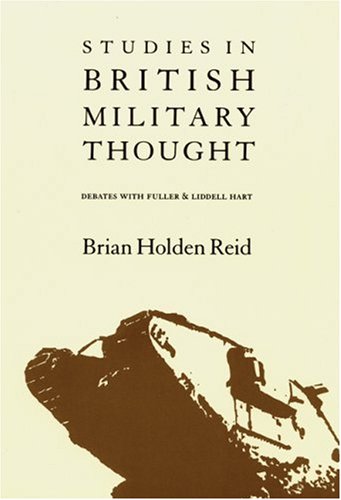
Studies in British Military Thought: Debates With Fuller and Liddell Hart
📄 Viewing lite version
Full site ›
Book Details
Author(s)Brian Holden Reid
PublisherUniversity of Nebraska Press
ISBN / ASIN0803239270
ISBN-139780803239272
Sales Rank5,095,809
CategoryTechnology & Engineering
MarketplaceUnited States 🇺🇸
Description ▲
John Frederick Charles Fuller (1878–1966), British soldier, military analyst, and war historian, is considered the father of modern armored (tank) warfare—first as planner of the attack at Cambrai in November 1917, and then as author of a number of works that challenged traditional British military thought. His ideas were resisted in his own country but had a major impact on German and Soviet military doctrine. Sir Basil Liddell Hart (1895–1970) was also a British military historian and analyst of note and authored influential military histories covering figures from Scipio Africanus to Field Marshal Rommel.
More Books in Technology & Engineering
Marine and Freshwater Products Handbook
View
Progress in Semiconductor Materials V: Volume 891: Nov…
View
X-Ray Computed Tomography in Biomedical Engineering
View
Wastewater Reuse - Risk Assessment, Decision-Making an…
View
Wideband CDMA for Third Generation Mobile Communicatio…
View
Food Analysis (Food Science Text Series)
View
Pulse Width Modulated (PWM) Power Supplies (Volume 45)…
View
Antifouling Paint Biocides (Water Pollution)
View