No visitor to Mexico can fail to recognize the omnipresence of street vendors, selling products ranging from fruits and vegetables to prepared food and clothes. The vendors compose a large part of the informal economy, which altogether represents at least 30 percent of Mexico’s economically active population. Neither taxed nor monitored by the government, the informal sector is the fastest growing economic sector in the world.
In Street Democracy Sandra C. Mendiola García explores the political lives and economic significance of this otherwise overlooked population, focusing on the radical street vendors during the 1970s and 1980s in Puebla, Mexico’s fourth-largest city. She shows how the Popular Union of Street Vendors challenged the ruling party’s ability to control unions and local authorities’ power to regulate the use of public space. Since vendors could not strike or stop production like workers in the formal economy, they devised innovative and alternative strategies to protect their right to make a living in public spaces. By examining the political activism and historical relationship of street vendors to the ruling Institutional Revolutionary Party (PRI), Mendiola García offers insights into grassroots organizing, the Mexican Dirty War, and the politics of urban renewal, issues that remain at the core of street vendors’ experience even today.
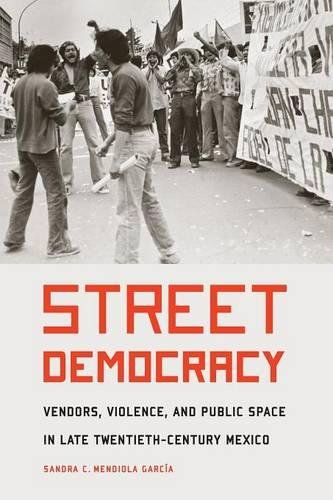
Street Democracy: Vendors, Violence, and Public Space in Late Twentieth-Century Mexico (The Mexican Experience)
📄 Viewing lite version
Full site ›
Book Details
Author(s)Sandra C. Mendiola Garcia
PublisherUniversity of Nebraska Press
ISBN / ASIN0803269714
ISBN-139780803269712
AvailabilityUsually ships in 24 hours
Sales Rank1,284,747
MarketplaceUnited States 🇺🇸
Description ▲
Similar Products ▼
- Taken
- Specters of Revolution: Peasant Guerrillas in the Cold War Mexican Countryside
- Signs Preceding the End of the World
- The Punitive City: Privatised Policing and Protection in Neoliberal Mexico
- Rural Resistance in the Land of Zapata: The Jaramillista Movement and the Myth of the Pax-Priísta, 1940–1962
- Courage, Resistance, and Women in Ciudad Juárez: Challenges to Militarization (Inter-America)
- Rebel Mexico: Student Unrest and Authoritarian Political Culture During the Long Sixties
- The Logic of Compromise in Mexico: How the Countryside Was Key to the Emergence of Authoritarianism
- Weavers of Revolution: The Yarur Workers and Chile's Road to Socialism
- Visions of Power in Cuba: Revolution, Redemption, and Resistance, 1959-1971 (Envisioning Cuba)