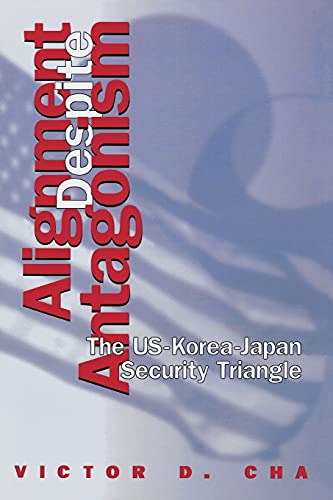
Alignment Despite Antagonism: The United States-Korea-Japan Security Triangle (Studies of the Weatherhead East Asian Institute, Columbia University)
📄 Viewing lite version
Full site ›
Book Details
Author(s)Cha, Victor D.
PublisherStanford University Press
ISBN / ASIN0804731926
ISBN-139780804731928
AvailabilityIn Stock.
Sales Rank927,707
CategoryPolitical Science
MarketplaceUnited States 🇺🇸
Description ▲
Japan and the Republic of Korea (ROK) have been two of the most critical pillars of peace, stability, and prosperity in the Asia-Pacific region for the past thirty years. At the same time, their relationship has fluctuated markedly and unpredictably. Despite the existence of a common ally in the United States and common security threats from the former Soviet Union, China, and North Korea, bilateral relations between Japan and South Korea have been persistently marred by friction. In the first in-depth study of this puzzling relationship in over fifteen years, the author compares the commonly accepted explanation for this relationship historical enmity with one that focuses on policies of the United States as the key driver of Japan-ROK relations. He finds that while history and emotion certainly affect the ways in which Japanese and Koreans regard each other, cooperation and dissension in the relationship are better understood through what he calls a quasi-alliance model: two states that remain unallied but have a third party as a common ally. This model finds that the normal state of Japan-ROK relations is characterized by friction that stems not only from history, but also from fundamental asymmetries in Japanese and Korean expectations of support from each other. The author shows, however, that in periods when the American defense commitment to the region is weak, Japan-ROK relations exhibit significantly less contention over bilateral issues. Without the prop of U.S. assistance, the two countries are seemingly willing to overlook the usual causes of friction and to adopt a more pragmatic approach. The author discusses the effects of democratization and the post-Cold War era on the triangular relationship, and addresses the prospects of a united Korea and its future relations with Japan, the United States, and China. The book covers the period from 1965 to 1998 and draws on recently declassified U.S. documents, internal Korean government documents, and interviews with former policy makers in the United States, Japan, and Korea.
More Books in Political Science
The Millennium Development Goals and Beyond: Internati…
View
Transnational Networks in Regional Integration: Govern…
View
Forensic Psychophysiology Using the Polygraph: Scienti…
View
Gender, Islam and Democracy in Indonesia (ASAA Women i…
View
E-Governance: A Change Management Tool
View
Shop Floor Bargaining and the State: Historical and Co…
View
Red State Uprising: How to Take Back America
View
A Community Health Approach to the Assessment of Infan…
View
Foreign Aid and Landmine Clearance: Governance, Politi…
View