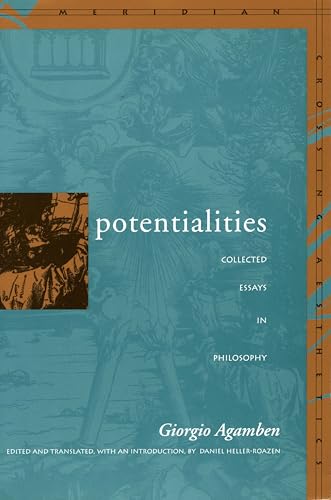
Potentialities: Collected Essays in Philosophy
📄 Viewing lite version
Full site ›
Book Details
Author(s)Giorgio Agamben
PublisherStanford University Press
ISBN / ASIN0804732787
ISBN-139780804732789
AvailabilityUsually ships in 24 hours
Sales Rank857,664
CategoryLanguage Arts & Disciplines
MarketplaceUnited States 🇺🇸
Description ▲
This book collects fifteen major philosophical essays written over a period of more than twenty years by acclaimed Italian philosopher Giorgio Agamben. The volume opens with an introduction in which the editor situates Agamben's work with respect to both the history of philosophy and contemporary European thought. The essays that follow articulate a series of theoretical confrontations with privileged figures in the history of philosophy, politics, and criticism, from Plato to Spinoza, Aristotle to Deleuze, Carl Schmitt to Benjamin, Hegel to Aby Warburg, and Heidegger to Derrida. Three fundamental concepts organize the collection as a whole: language, in the sense not of particular statements but rather the very taking place of speech, the pure fact of language's existence; history, as it appears from a perspective in which tradition, transmission, and memory reach their messianic fulfillment; and potentiality, understood as a fundamental problem of metaphysics, ethics, and the philosophy of language. All these topics converge in the final part of the book, in which Agamben offers an extensive reading of Melville's short story "Bartleby the Scrivener" as a work that puts potentiality and actuality, possibility and reality, in an altogether new light.
More Books in Language Arts & Disciplines
The Quest for Charisma: Christianity and Persuasion
View
Read the Way You Talk: A Guide for Lectors
View
Focus on the Caribbean (Varieties of English Around th…
View
How to Write a Novel; A Practical Guide to the Art of …
View
How to Write and Sell Mystery Fiction
View
Politically Speaking: A Worldwide Examination of Langu…
View
The Memoir Book
View
The Subjunctive in the Age of Prescriptivism: English …
View
Invisible Acts of Power: Channeling Grace in Your Ever…
View
Describing Spoken English: An Introduction (Routledge …
View