This book is a political history of economic life. Through a description of the convulsions of long-term change from colony to republic in Buenos Aires, Republic of Capital explores Atlantic world transformations in the eighteenth and nineteenth centuries.
Tracing the transition from colonial Natural Law to instrumental legal understandings of property, the book shows that the developments of constitutionalism and property law were more than coincidences: the polity shaped the rituals and practices arbitrating economic justice, while the crisis of property animated the support for a centralized and executive-dominated state. In dialectical fashion, politics shaped private law while the effort to formalize the domain of property directed the course of political struggles.
In studying the legal and political foundations of Argentine capitalism, the author shows how merchants and capitalists coped with massive political upheaval and how political writers and intellectuals sought to forge a model of liberal republicanism. Among the topics examined are the transformation of commercial law, the evolution of liberal political credos, and the saga of political and constitutional turmoil after the collapse of Spanish authority.
By the end of the nineteenth century, statemakers, capitalists, and liberal intellectuals settled on a model of political economy that aimed for open markets but closed the polity to widespread participation. The author concludes by exploring the long-term consequences of nineteenth-century statehood for the following century's efforts to promote sustained economic growth and democratize the political arena, and argues that many of Argentina's recent problems can be traced back to the framework and foundations of Argentine statehood in the nineteenth century.
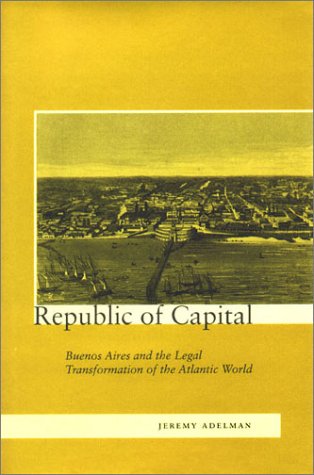
Republic of Capital: Buenos Aires and the Legal Transformation of the Atlantic World
📄 Viewing lite version
Full site ›
Book Details
Author(s)Jeremy Adelman
PublisherStanford University Press
ISBN / ASIN0804733791
ISBN-139780804733793
AvailabilityUsually ships in 24 hours
Sales Rank1,556,583
CategoryHistory
MarketplaceUnited States 🇺🇸
Description ▲
More Books in History
The Bet, and Other Stories
View
Pakistan and the Bomb: Public Opinion and Nuclear Opti…
View
Writing National Histories: Western Europe Since 1800
View
Empire in Eclipse
View
Monks and Laymen in Byzantium, 843-1118
View
The Wilmington and Western Railroad (Images of Rail: D…
View
Black Sailor, White Navy: Racial Unrest in the Fleet d…
View
Feasibility of Laser Power Transmission to a High-Alti…
View
The Democratic Republic: 1801-1815
View
The Majesty of Egyptian Gods and Temples: A Book of Eg…
View