Traditional historiography describes the repartimiento de mercancÃas as a forced system of production and consumption in which officials of the Spanish crown compelled Mexican Indians to produce goods marketable in the Spanish economy and to purchase expensive and undesired Spanish products. The author challenges this conventional portrayal of Indian-Spanish economic relations by arguing that Indian market behavior was economically rational and voluntary. He further argues that the repartimiento was an institution designed to overcome market imperfections inherent in Mexico's colonial economy and to facilitate the extension of credit in a cross-cultural environment.
Examining repartimiento production of cochineal, a dyestuff produced exclusively by Oaxacan Indians and representing Mexico's most valued export after silver, this study shows that Indians produced cochineal for the market voluntarily because it provided them with needed income. The primary role of the repartimiento was to provide Mexico's indigenous peasantry with credit, without which they could not have participated in the market as extensively as they did. Owing to the difficulty of collecting debts, credit provision was monopolized by agents of the Crown, the alcaldes mayores, who alone possessed the legal leverage needed to enforce the payment of debts. Though Spanish officials profited from the repartimiento, their economic gains were not so great as traditionally believed.
Overall, the book demonstrates that Mexican Indians were much more actively engaged in the market than customarily imagined, and were adept at promoting their interests despite the discriminating policies of colonialism. The book rounds out its account of the repartimiento by examining the transatlantic trade in cochineal, especially in its late colonial decline.
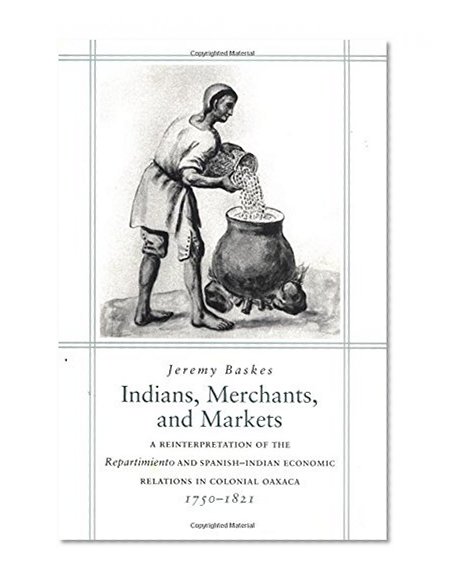
Indians, Merchants and Markets: A Reinterpretation of the Repartimiento and Spanish-Indian Economic Relations in Colonial Oaxaca, 1750-1821.
📄 Viewing lite version
Full site ›
Book Details
Author(s)Jeremy Baskes
PublisherStanford University Press
ISBN / ASIN0804735123
ISBN-139780804735124
AvailabilityUsually ships in 24 hours
Sales Rank3,860,015
CategoryHistory
MarketplaceUnited States 🇺🇸
Description ▲
More Books in History
The Bet, and Other Stories
View
Pakistan and the Bomb: Public Opinion and Nuclear Opti…
View
Writing National Histories: Western Europe Since 1800
View
Empire in Eclipse
View
Monks and Laymen in Byzantium, 843-1118
View
The Wilmington and Western Railroad (Images of Rail: D…
View
Black Sailor, White Navy: Racial Unrest in the Fleet d…
View
Feasibility of Laser Power Transmission to a High-Alti…
View
The Democratic Republic: 1801-1815
View