This volume aims both to establish cinema as a vital force in Shanghai culture and to direct attention to early Chinese cinema, a crucial chapter in Chinese cultural history long neglected by Western scholars.
The editor’s introduction surveys the history and historiography of Chinese cinema through the 1940’s and identifies subjects and sources that await further research. In Part I, ?Screening Romance,” Zhen Zhang discusses how the influence of teahouse culture gradually yielded to cinematic and narrative concerns in the early 1920’s. Kristine Harris’s analysis of a costume drama reveals the director’s cultural heritage and a rich psychological subtext created by new film techniques. Leo Ou-fan Lee examines the ways various urban institutions were utilized to promote a certain type of film culture in Shanghai.
In Part II, ?Imaging Sexuality,” Andrew Field traces the public perception of cabaret girls in Shanghai, and Michael Chang studies the discursive processes by which three generations of early movie stars were elevated to stardom. Yingjin Zhang contends that prostitution was a focal point in the urban imagination and that its public presentation furnished Chinese filmmakers with a highly contested space for projecting different ideologies.
In Part III, ?Constructing Identity,” Zhiwei Xiao examines the role Nationalist film censorship played in promoting a new national culture, and Sue Tuohy locates in film music a wide range of conflicting ideals and models. Shelley Stephenson brings us to Japanese-occupied Shanghai, where a Manchurian-born, Chinese-educated Japanese film star masked her true identity.
Representing the disciplines of film, literature, and ethnomusicology, the contributors seek to redefine concepts of cinema and urban culture in Chinese historiography. The volume will appeal to scholars whose interests lie, not just in film studies and Chinese history, but in the fields of modernity, urban studies, and popular culture.
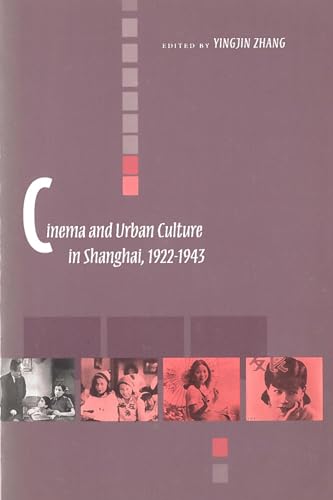
Cinema and Urban Culture in Shanghai, 1922-1943
📄 Viewing lite version
Full site ›
Book Details
PublisherStanford University Press
ISBN / ASIN0804735727
ISBN-139780804735728
AvailabilityUsually ships in 2 to 3 weeks
Sales Rank935,984
CategoryPerforming Arts
MarketplaceUnited States 🇺🇸
Description ▲
More Books in Performing Arts
A Producer's Broadway Journey
View
Odin Teatret: Theatre in a New Century
View
Voice and the Actor
View
The Art of Avatar: James Cameron's Epic Adventure
View
The Sitcom Reader: America Viewed and Skewed
View
Film and Ethics
View
Documentary (Routledge Film Guidebooks)
View
Writing A Great Script Fast Workbook: Story For Digita…
View