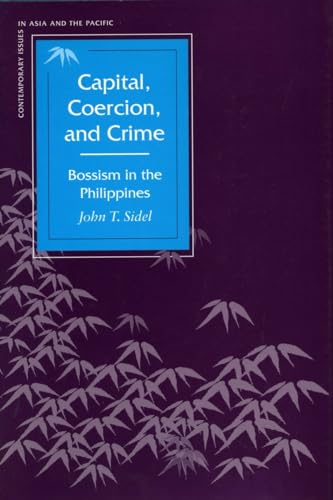
Capital, Coercion, and Crime: Bossism in the Philippines (Contemporary Issues in Asia and the Pacific)
📄 Viewing lite version
Full site ›
Book Details
Author(s)John T. Sidel
PublisherStanford University Press
ISBN / ASIN0804737460
ISBN-139780804737463
AvailabilityUsually ships in 24 hours
Sales Rank973,088
CategoryPolitical Science
MarketplaceUnited States 🇺🇸
Description ▲
This book focuses on local bossism, a common political phenomenon where local power brokers achieve monopolistic control over an area's coercive and economic resources. Examples of bossism include Old Corruption in eighteenth-century England, urban political machines in the United States, caciques in Latin America, the Mafia in Southern Italy, and today's gangster politicians in such countries as India, Russia, and Thailand. For many years, the entrenchment of numerous provincial warlords and political clans has made the Philippines a striking case of local bossism. Yet writings on Filipino political culture and patron-client relations have ignored the role of coercion in shaping electoral competition and social relations. Portrayals of a "weak state" captured by a landed oligarchy have similarly neglected the enduring institutional legacies of American colonial rule and the importance of state resources for the accumulation of wealth and power in the Philippines. The author, by contrast, argues that the roots of bossism in the Philippines lie in the inauguration of formal democratic institutions at a relatively early stage of capitalist development. Poverty and insecurity leave many voters vulnerable to clientelist, coercive, and financial pressure, and the state's central role in capital accumulation provides the basis for local bosses' economic empires and political machines. These contradictions have encouraged bossism in the Philippines, as well as in other countries. The book elaborates these arguments through case studies of bosses in two Philippine provinces, Cavite and Cebu. The contrast between single-generation gangster politicians in Cavite and enduring commercial dynasties in Cebu reveals variation in the forms of bossism that reflect variations in the local political economies of the two provinces. Comparisons between bosses over successive historical periods highlight the gradual transformation of bossism through capitalist development. In sum, Capital, Coercion, and Crime provides a comparative historical analysis of bossism, drawing conclusions of great interest not only to scholars of Southeast Asia but to students of comparative politics as well.
More Books in Political Science
Building Citizenship: Civics and Economics, Student Ed…
View
Congress For Dummies
View
Selections from The Wealth of Nations (Crofts Classics)
View
Comparative Approaches to Program Planning
View
Justice Administration: Police, Courts, and Correction…
View
Practical Spirituality: The Spiritual Basis of Nonviol…
View
The Other America: Poverty in the United States
View
The Fatal Conceit: The Errors of Socialism (Volume 1) …
View
Governing the Commons (Canto Classics)
View
Dead Aid: Why Aid Is Not Working and How There Is a Be…
View
FBI Handbook of Crime Scene Forensics: The Authoritati…
View