The basic thesis of this book is that the well known and extensively studied Indo-European family of languages is but a branch of a much larger Eurasiatic family that extends from northern Asia to North America. Eurasiatic is seen to consist of Indo-European, Uralic-Yukaghir, Altaic (Turkic, Mongolian, and Tungus-Manchu), Japanese-Korean-Ainu (possibly a distinct subgroup of Eurasiatic), Gilyak, Chuckchi-Kamchatkan, and Eskimo-Aleut. The author asserts that the evidence for the validity of Eurasiatic as a single linguistic family, including the vocabulary evidence to be presented in Volume II on semantics, confirms his hypothesis since the numerous and interlocking resemblances he finds among the various subgroups can only reasonably be explained by descent from a common ancestor.
The evidence in this volume deals in great detail with the distribution of 72 grammatical elements and the forms they take in the various Eurasiatic languages. The book also contains a historical introduction and a discussion of certain phonological phenomena. Of these phenomena, the most important is the vocal-harmony system found in many of these languages that is the ancestor of the so-called Ablaut variations of vowels in Indo-European, still seen in English in such contrasts as ?come”/”came.” The origin and earliest form of this system have long been a puzzle to Indo-Europeanists, but in this work they are shown to be the outcome of this original system.
An appendix deals with the vowel variation of Ainu, which resembles that of other languages in Eurasiatic. The origin of the Ainu has hitherto been considered a great mystery, and this volume shows a north Asian origin, not, as some have thought, one in Southeast Asia or the Pacific. The book also includes a Classification of Eurasiatic Languages and an Index of the Etymologies.
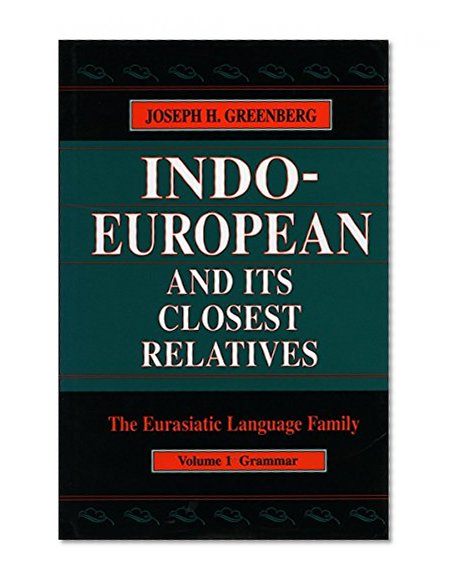
Indo-European and Its Closest Relatives: The Eurasiatic Language Family, Volume 1, Grammar
📄 Viewing lite version
Full site ›
⌛ 🇮🇳 India pricing being fetched…
Prices will appear once fetched — usually within a few minutes.
View in:
🇺🇸 USA
Book Details
Author(s)Joseph Greenberg
PublisherStanford University Press
ISBN / ASIN0804738122
ISBN-139780804738125
CategoryLanguage Arts & Disciplines
MarketplaceIndia 🇮🇳
Description ▲
More Books in Language Arts & Disciplines
The Quest for Charisma: Christianity and Persuasion
View
Read the Way You Talk: A Guide for Lectors
View
Focus on the Caribbean (Varieties of English Around th…
View
How to Write a Novel; A Practical Guide to the Art of …
View
How to Write and Sell Mystery Fiction
View
Politically Speaking: A Worldwide Examination of Langu…
View
The Memoir Book
View
The Subjunctive in the Age of Prescriptivism: English …
View
Invisible Acts of Power: Channeling Grace in Your Ever…
View