Focusing on two late-Ming or early-Qing plays central to the Chinese canon, this thought-provoking study explores crucial questions concerning personal identity. How is a person, as opposed to a ghost or animal, to be defined? How can any specific person (as distinguished, for example, from an impostor or twin) be identified? Both plays are chuanqi, representatives of a monumental genre that represents Chinese dramatic literature at its most complex: Tang Xianzu's Peony Pavilion is a romantic comedy in 55 acts, and Kong Shangren's Peach Blossom Fan narrates the fall of the Ming Dynasty in 40 acts.
No reader of Chinese literature would find a sexual encounter between a young man and a female ghost surprising. In Peony Pavilion, however, the lovers actually marry and join human society—a possibility that invites speculation on the nature of personhood and agency. By contrast, Peach Blossom Fan addresses the question of identity in an explicitly political fashion. After the fall of Beijing, many men put forward imperial claims. Who, in a time of turmoil, is truly the Emperor? In a Confucian society, where hierarchy and identity are so interdependent, how does the lack of certainty about the Emperor's identity affect all human identities?
The question of personal identity is intrinsically bound up with questions of agency, legal responsibility, and participation within a polity. Confucian patriarchy, in particular, implies an anxiety of identity: in order to serve one's father appropriately, one must first know who he is. Drawing on related contemporary sources, the author combines a range of perspectives, including literary criticism, philosophy, jurisprudence, and art history.
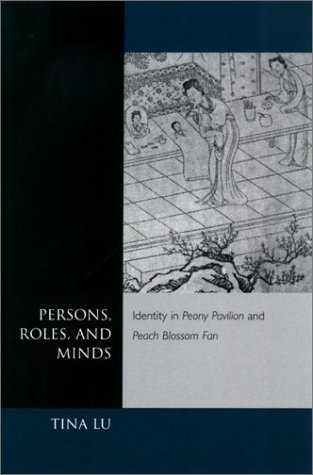
Persons, Roles, and Minds: Identity in Peony Pavilion and Peach Blossom Fan
📄 Viewing lite version
Full site ›
⌛ 🇫🇷 France pricing being fetched…
Prices will appear once fetched — usually within a few minutes.
View in:
🇺🇸 USA
Book Details
Author(s)Tina Lu
PublisherStanford University Press
ISBN / ASIN0804742022
ISBN-139780804742023
CategoryLiterary Criticism
MarketplaceFrance 🇫🇷
Description ▲
More Books in Literary Criticism
Egyptian Literature
View
Utopia Paraiso E Historia: Inscripciones Del Mito En G…
View
Nation, State, and Empire in English Renaissance Lite…
View
On the Outskirts of Form: Practicing Cultural Poetics
View
Genre at the Crossroads: The Challenge of Fantasy
View
Profiles in Canadian Drama: James Reaney
View
Monty Python, Shakespeare and English Renaissance Drama
View
Modes of Faith: Secular Surrogates for Lost Religious …
View
Latino Los Angeles in Film and Fiction: The Cultural P…
View