Search Books

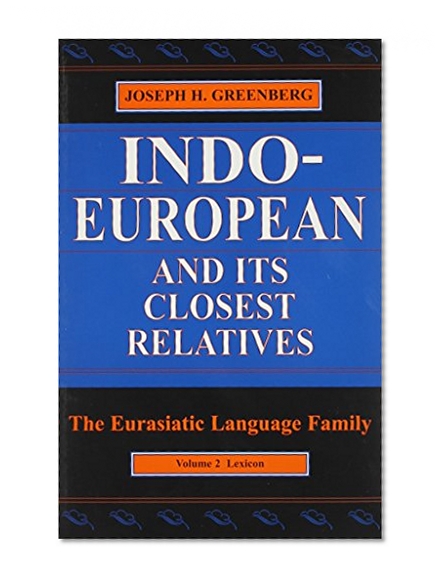
Indo-European and Its Closest Relatives: The Eurasiatic Language Family, Volume 2, Lexicon

Author Joseph Greenberg
Publisher Stanford University Press
📄 Viewing lite version Full site ›
🌎 Shop on Amazon — choose country
57.50 USD
🛒 Buy New on Amazon 🇺🇸 🏷 Buy Used — $44.20

✓ Usually ships in 24 hours

Share:
Book Details
ISBN / ASIN0804746249
ISBN-139780804746243
AvailabilityUsually ships in 24 hours
Sales Rank3,702,481
MarketplaceUnited States 🇺🇸

Description

The basic thesis of this two-volume work (Volume I. Grammar was published in 2000) is that the well known and extensively studied Indo-European family of languages is but a branch of a much larger Eurasiatic family that extends from Europe across northern Asia to North America. Eurasiatic is seen to consist of Indo-European, Uralic-Yukaghir, Altaic (Turkic, Mongolian, and Tungus-Manchu), Japanese-Korean-Ainu (possibly a distinct subgroup of Eurasiatic), Gilyak, Chukotian, and Eskimo-Aleut. The author asserts that the evidence presented in the two volumes for the validity of Eurasiatic as a single linguistic family confirms his hypothesis since the numerous and interlocking resemblances he finds among the various subgroups can only reasonably be explained by descent from a common ancestor.

The present volume provides lexical evidence for the validity of Eurasiatic as a linguistic stock. Since some of the relevant etymological material has already been published in the work of some Nostraticists, this volume emphasizes those etymologies involving Ainu, Gilyak, Chukotian, and Eskimo-Aleut, languages generally omitted from Nostratic studies. The Eurasiatic family is itself most closely related to the Amerind family, with which it shares numerous roots. The Eurasiatic-Amerind family represents a relatively recent expansion (circa 15,000 BP) into territory opened up by the melting of the Arctic ice cap. Eurasiatic-Amerind stands apart from the other families of the Old World, among which the differences are much greater and represent deeper chronological groupings.

The volume includes a classification of Eurasiatic languages, references cited, and semantic and phonetic indexes.