Quod non est in actis, non est in mundo. (What is not on file is not in the world.) Once files are reduced to the status of stylized icons on computer screens, the reign of paper files appears to be over. With the epoch of files coming to an end, we are free to examine its fundamental influence on Western institutions. From a media-theoretical point of view, subject, state, and law reveal themselves to be effects of specific record-keeping and filing practices. Files are not simply administrative tools; they mediate and process legal systems. The genealogy of the law described in Vismann's Files ranges from the work of the Roman magistrates to the concern over one's own file, as expressed in the context of the files kept by the East German State Security. The book concludes with a look at the computer architecture in which all the stacks, files, and registers that had already created order in medieval and early modern administrations make their reappearance.
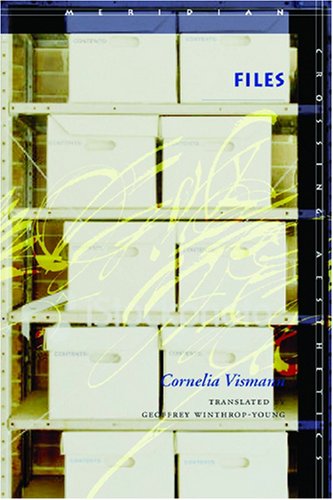
Files: Law and Media Technology (Meridian: Crossing Aesthetics)
📄 Viewing lite version
Full site ›
⌛ 🇬🇧 United Kingdom pricing being fetched…
Prices will appear once fetched — usually within a few minutes.
View in:
🇺🇸 USA
Book Details
Author(s)Cornelia Vismann
PublisherStanford University Press
ISBN / ASIN080475151X
ISBN-139780804751513
CategoryComputers
MarketplaceUnited Kingdom 🇬🇧
Description ▲
More Books in Computers
Windows XP, Vol. 1 (SELECT Series)
View
Internet Searching and Indexing: The Subject Approach
View
Control Problems in Industry: Proceedings from the SIA…
View
Open Source Systems Security Certification
View
Java: Data Structures and Programming
View
User-Centered Web Development
View
Query Processing in Database Systems (Topics in Inform…
View
Fundamentals of SQL Server 2005
View
Dreamweaver CS4: The Missing Manual (Spanish Edition)
View