What role do legal trials have in collective processes of coming to terms with a history of mass violence? How does the theatrical structure of a criminal trial facilitate and limit national processes of healing and learning from the past? This study begins with the widely publicized, historic trials of three Nazi war criminals, Eichmann, Barbie, and Priebke, whose explicit goal was not only to punish, but also to establish an officially sanctioned version of the past. The Truth and Reconciliation commissions in South America and South Africa added a therapeutic goal, acting on the belief that a trial can help bring about a moment of closure.
Horsman challenges this belief by reading works that reflect on the relations among pedagogy, therapy, and legal trials. Philosopher Hannah Arendt, poet Charlotte Delbo, and dramaturg Bertolt Brecht all produced responses to historic trials that reopened the cases those trials sought to close, bringing to center stage aspects that had escaped the confines of their legal frameworks.
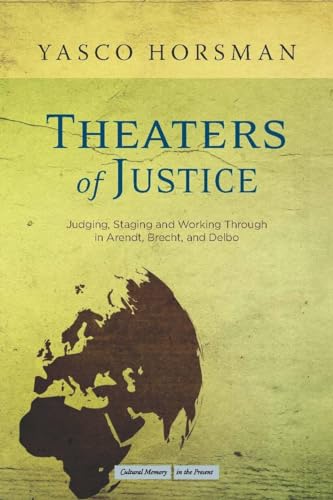
Theaters of Justice: Judging, Staging, and Working Through in Arendt, Brecht, and Delbo (Cultural Memory in the Present)
📄 Viewing lite version
Full site ›
Book Details
Author(s)Yasco Horsman
PublisherStanford University Press
ISBN / ASIN0804770328
ISBN-139780804770323
AvailabilityUsually ships in 24 hours
Sales Rank3,163,884
CategoryLiterary Criticism
MarketplaceUnited States 🇺🇸
Description ▲
More Books in Literary Criticism
Borges and the Politics of Form (Latin American Studie…
View
CliffsNotes on Achebe's Things Fall Apart (Dummies Tra…
View
The Acoustic World of Early Modern England: Attending …
View
The Land's Wild Music: Encounters with Barry Lopez, Pe…
View
Chemical Oscillations and Instabilities: Non-linear Ch…
View
Il romanzo al passato: Medioevo e invenzione in tre au…
View
Ghazali and the Poetics of Imagination (Islamic Civili…
View
History of My Life, Vols. 7 & 8
View