What does it mean to be a spectator to war in an era when the boundaries between witnessing and perpetrating violence have become profoundly blurred? Arguing that the contemporary dynamics of military spectatorship took shape in Napoleonic Europe, Watching War explores the status of warfare as a spectacle unfolding before a mass audience. By showing that the battlefield was a virtual phenomenon long before the invention of photography, film, or the Internet, this book proposes that the unique character of modern conflicts has been a product of imaginary as much as material forces.
Warfare first became total in the Napoleonic era, when battles became too large and violent to be observed firsthand and could only be grasped in the imagination. Thenceforth, fantasies of what war was or should be proved critical for how wars were fought and experienced. As war's reach came to be limited only by the creativity of the mind's eye, its campaigns gave rise to expectations that could not be fulfilled. As a result, war's modern audiences have often found themselves bored more than enthralled by their encounters with combat. Mieszkowski takes an interdisciplinary approach to this major ethical and political concern of our time, bringing literary and philosophical texts into dialogue with artworks, historical documents, and classics of photojournalism.
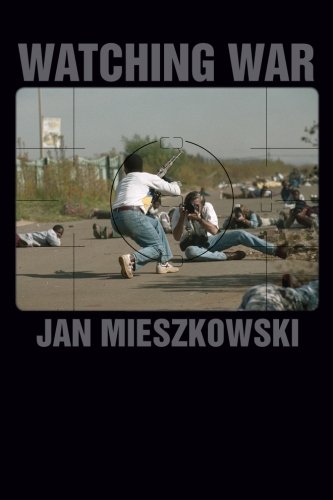
Watching War
📄 Viewing lite version
Full site ›
Book Details
Author(s)Jan Mieszkowski
PublisherStanford University Press
ISBN / ASIN0804782407
ISBN-139780804782401
AvailabilityUsually ships in 24 hours
Sales Rank1,437,255
CategoryLiterary Criticism
MarketplaceUnited States 🇺🇸
Description ▲
More Books in Literary Criticism
Borges and the Politics of Form (Latin American Studie…
View
CliffsNotes on Achebe's Things Fall Apart (Dummies Tra…
View
The Acoustic World of Early Modern England: Attending …
View
The Land's Wild Music: Encounters with Barry Lopez, Pe…
View
Chemical Oscillations and Instabilities: Non-linear Ch…
View
Il romanzo al passato: Medioevo e invenzione in tre au…
View
Ghazali and the Poetics of Imagination (Islamic Civili…
View
History of My Life, Vols. 7 & 8
View