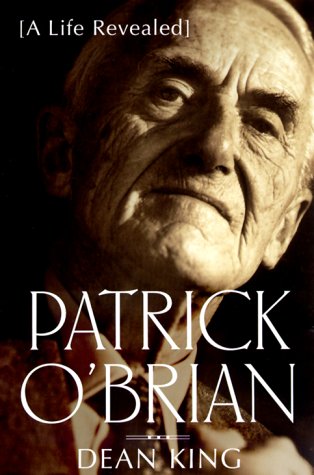
Hailed as the Irish author of "the greatest historical novels ever written"--the 20 swashbuckling Napoleonic-era adventures starring Captain Jack Aubrey and Stephen Maturin--Patrick O'Brian was not such a great guy. In fact, he wasn't really Patrick O'Brian: he was actually the Englishman Richard Patrick Russ, who abandoned his semiliterate Welsh wife and dying, spina bifida-plagued child in 1940 and reinvented himself as a writer and as a human being. He did well as a writer, winning kudos as a biographer (
Picasso), translator (
Papillon), and old literary sea lion. But he was less than humane, as Dean King's
A Life Revealed reveals. The son of a rotten father, Russ/O'Brian became a rotten father himself, cutting off all contact with his son, granddaughters, and even siblings. As he chillingly wrote in his biography, "Parents are supposed to love their children, yet surely there is the implied condition that the children should be reasonably lovable?" Though he was kinder to his second wife, the Countess Mary Tolstoy, whose reckless driving injured both of them, he once wrote that Picasso was "sucked dry and rendered sterile by women, children, routine." For his part, O'Brian preferred poverty and exile in Southern France with Mary--remote from his family origins, penning masterpieces in a house with books but no electricity or running water. Only in his 70s did he become rich and famous.
You can't deny the many striking parallels between O'Brian's life and his work--even though he did. Rotten fathers permeate his fiction, as the fathomless woe must have permeated him upon his mother's death from tuberculosis in 1918, when he was 4. It's great fun to read about his mad-inventor father's machine to cure VD by electrocuting the bladder and compare it to Maturin's practice and devices--and to hear about the future author's salty Uncle Morse telling the lad about encounters with pirates. Captain Aubrey clearly derives partly from Patrick's sociable man-of-action brother Mike (who changed his surname to O'Brien, another family defector). And of course Maturin proves to be in large part a self-portrait.
Fans of Aubrey and Maturin may find King's A Sea of Words (a lexicon of arcane terms that O'Brian uses) more delightful than his exposé of O'Brian's impressive yet appalling life, but it is one thorough and convincing exposé. --Tim Appelo