New York's Greenwich Village, writes Princeton University historian Christine Stansell in this engaging study, became the epicenter of this great social earthquake. Fueled by wealthy patrons and fed by refugees from Europe and the Midwest, New York's once isolated bohemian community generated social trends that would be widely copied, and in the process "made Greenwich Village into a beacon of American possibility in the new age." Among their number were the anarchist politician Emma Goldman, the radical journalists John Reed and Louise Bryant, and the writers Eugene O'Neill and Kenneth Burke, all of whom insisted on making an art form of one's life--and on rattling a few cages while doing so. The individual actors in this social revolution, Stansell observes, may be little remembered today, but elements of their belief--openness in social relationships, equality among men and women, and "a skepticism at once relentlessly questioning of America and entirely embroiled in its future"--are our common coin today. --Gregory McNamee
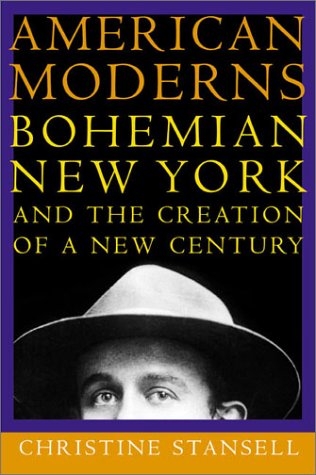
American Moderns: Bohemian New York and the Creation of a New Century
📄 Viewing lite version
Full site ›
Book Details
Author(s)Christine Stansell
PublisherHolt Paperbacks
ISBN / ASIN0805067353
ISBN-139780805067354
Sales Rank1,151,982
MarketplaceUnited States 🇺🇸
Description ▲
"On or about December 1910," Virginia Woolf once wrote, "human character changed." In the great capitals of Europe and America, the gray veil of Victorian values lifted; modernism, once the province of a few artistic experimenters, took the fore; subjects hitherto not considered to be fit for polite society, from women's rights to free love, became the subjects of parlor discussion.