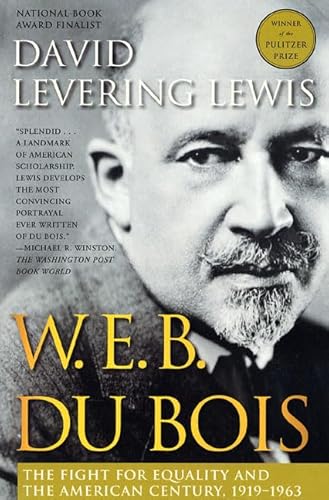
Lewis's lean and lyrical writing rescues Du Bois's stuffy, Afro-Victorian speech from historical documents, breathing life into his letters, memos, and numerous articles, both published and unpublished. He takes us through Du Bois's battles with the NAACP (which he cofounded); his ideological wars with "Back to Africa" nationalist Marcus Garvey; his many Pan-African conferences; and his tours of Africa, Japan, Russia, and China. He probes deeply into many of Du Bois's books, including Darkwater: Voices from Within the Veil and Black Reconstruction, adding marvelous new insights into the neglected novel Dark Princess. Lewis also details Du Bois's relationships with friends and foes alike, including James Weldon Johnson, Walter White, and Alain Locke, as well as his triumphs, such as his acquittal in the infamous trial in which he was accused of being an "unregistered foreign agent," and his defeats, notably his failure to publish his Encyclopedia Africana.
A foremost authority on this great man, Lewis summarizes Du Bois as having "an extraordinary mind of color in a racialized century ... possessed of a principled impatience with what he saw as the egregious failings of American democracy that drove him, decade by decade, to the paradox of defending totalitarianism in the service of a global idea of economic and social justice." A reading of this magnificent work is nothing less than a reading of modern black America. --Eugene Holley Jr.