This volume focuses on two related questions that are central to both the psychology of mathematical thinking and learning and to the improvement of mathematics education:
What is the nature of arithmetic expertise?
How can instruction best promote it?
Contributors from a variety of specialities, including cognitive, developmental, educational, and neurological psychology; mathematics education; and special education offer theoretical perspectives and much needed empirical evidence about these issues.
As reported in this volume, both theory and research indicate that the nature of arithmetic expertise and how to best promote it are far more complex than conventional wisdom and many scholars, past and present, have suggested. The results of psychological, educational, and clinical studies using a wide range of arithmetic tasks and populations (including "normally" and atypically developing children, non-injured and brain-injured adults, and savants) all point to the same conclusion: The heart of arithmetic fluency, in general, and the flexible and creative use of strategies, in particular, is what is termed "adaptive expertise" (meaningful or conceptually based knowledge). The construction of adaptive expertise in mathematics is, for the first time, examined across various arithmetic topics and age groups.
This book will be an invaluable resource for researchers and graduate students interested in mathematical cognition and learning (including mathematics educators, developmental and educational psychologists, and neuropsychologists), educators (including teachers, curriculum supervisors, and school administrators), and others interested in improving arithmetic instruction (including officials in national and local education departments, the media, and parents).
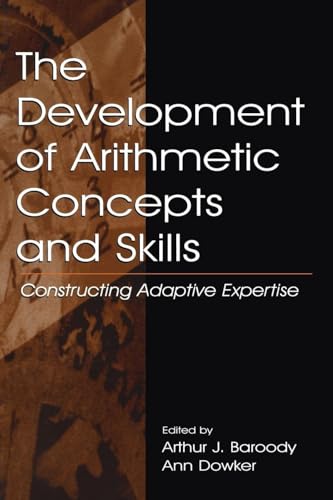
The Development of Arithmetic Concepts and Skills (Studies in Mathematical Thinking and Learning Series)
📄 Viewing lite version
Full site ›
Book Details
Author(s)Routledge
PublisherRoutledge
ISBN / ASIN0805831568
ISBN-139780805831566
AvailabilityIn Stock
CategoryPaperback
MarketplaceUnited States 🇺🇸
Description ▲
More Books in Paperback
Nightmare Hour TV Tie-in Edition
View
First Light
View
The Miles Between
View
Prize Stories 1990: The O. Henry Awards (Pen / O. Henr…
View
Democracy Begins Between Two
View
The Model Locomotive Engineer, Fireman, and Engine Boy
View
Bloodline in the Sand
View
Making America, Volume A, Brief, 2nd Ed + Perfect Unio…
View
Ellis, Becoming a Master Student, 11th Edition Plus My…
View