The affective realm is a critical, but often forgotten, aspect of schooling. The development of character and the formation of appropriate learning environments rely to a large extent on understanding the affective nature of students. Even when the focus is on cognitive achievement, affect has a role to play. Teachers frequently mention a lack of motivation as a primary reason for students not achieving as well as they should or as well as their teachers would like.
Despite the importance of affect, educators rarely make an effort to systematically collect and use information about students' affective characteristics to better understand students and to substantially improve the quality of education they receive. This book's purpose is to provide educators with the knowledge and skills they need to design and select instruments that can be used to gather information about students' affective characteristics. Once valid and reliable information has been gathered, it can be used to aid in understanding and to improve educational quality.
The second edition features:
* an updated list of affective characteristics (i.e., attitudes, values, interests, self-esteem, self-efficacy, locus of control)
* a dual emphasis on selecting and designing affective assessment instruments
* an emphasis on multi-scale instruments (i.e., a single instrument with multiple affective scales)
* the use of a single small data set to illustrate and foster understanding of key concepts and procedures
* a dual emphasis on data about individual students and groups of students
* a dual focus on the instrumental value of affective data and the inherent value of affective data (i.e., affect is valuable in and of itself)
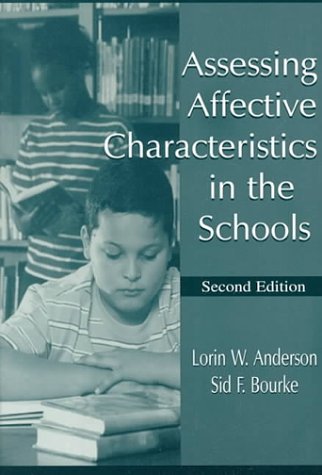
Assessing Affective Characteristics in the Schools
📄 Viewing lite version
Full site ›
Book Details
Author(s)Lorin W. Anderson, Sid F. Bourke
PublisherRoutledge
ISBN / ASIN0805831983
ISBN-139780805831986
AvailabilityUsually ships in 24 hours
Sales Rank838,214
MarketplaceUnited States 🇺🇸