This developmentally sound, research-based, practical text speaks directly to preservice elementary mathematics students about the multitude of ways they can help their future students learn to see the power, beauty, necessity, and usefulness of mathematics in the world.Part 1 deals with guiding principles that permeate the text, while Parts 2-11 deal with the specific NCTM Standards for grades K-6. Teaching K-6 Mathematics:
*is aligned with the current NCTM Curriculum and Evaluation Standards for School Mathematics;
*integrates content and methodology;
*emphasizes use of technology as a teaching/learning tool;
*stresses problem solving;
*provides basic information on current research in mathematics education;
*focuses on identification of error patterns and analysis;
*uses a down-to-earth, friendly writing style that engages the student rather than prescribing what to do; and
*includes many activities and exercises, including games, tricks, and amusements that can be used in the classroom to increase student interest in mathematics.
Features:
*Technology is integral throughout the text. Students are expected to perform Internet searches, investigate new sites appropriate for elementary students, sample new software that could be used in the classroom, and develop ways to blend calculators into the curriculum.
*Manipulatives are considered essential for students to learn elementary mathematics concepts. Cuisenaire rods, base 10- blocks, chips, number lines, and geoboards are all part of the manipulative landscape that is created in this text.
*Careful attention is given to blending rote work, developmental activities, fun, application, technology, manipulatives, assessment, and planning, so that prospective teachers become accustomed to using varied approaches and decision making as a curriculum is determined.
*Tricks, Activities, and Games (TAG) provide a wealth of ideas to attract students to learning mathematics.
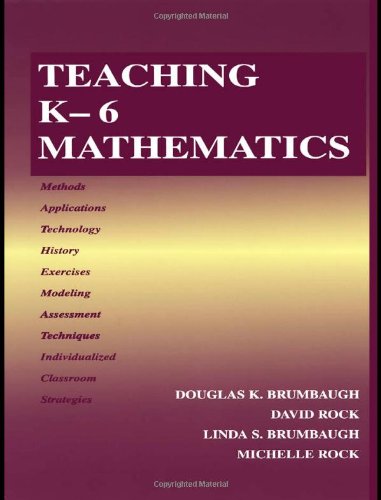
Teaching K-6 Mathematics
📄 Viewing lite version
Full site ›
Book Details
PublisherRoutledge
ISBN / ASIN0805832688
ISBN-139780805832686
AvailabilityUsually ships in 24 hours
Sales Rank3,912,977
MarketplaceUnited States 🇺🇸