This book is the first study to examine how interactional style develops within the walls of a foreign language classroom in the first two years of language study. Results show learners to be highly sensitive to pragmatic information and that learners can move toward an appropriate interactional style through classroom interactive experience.
The book shows how learners are most often sources who offer assistance and correction, with errors serving most often to stimulate further thinking about what form is correct. Analysis shows learners to be active in seeking corrective information in the classroom setting, not only from peer partners but also from the teacher. They are active in noticing how the teacher's utterances--even when addressed to others--contrast with their own, and utilize corrective feedback intended for other students. In addition, the results show that teacher-initiated corrective feedback addressed to individual learners is only one source of corrective feedback. Learners are shown to be active in both teacher-fronted and peer interactive settings.
In newer L2 teaching methodologies which focus on the use of peer interactive tasks, the teacher's role has been de-emphasized. This book, however, shows how important the teacher's role is. The final chapter examines how the teacher can act to maximize the benefits of peer interactive tasks through how they design tasks and present them to the class. First, the chapter looks at how learners use English--their L1--in the classroom, concluding that how teachers present activities to the class has an impact on the amount of L1 used by students during peer interaction. Following up on this finding, the chapter works to address questions that teachers face in lesson planning and teaching. It presents a useful list of questions teachers can ask when designing peer interactive tasks in order to maximize the effectiveness of a wide variety of language learning tasks.
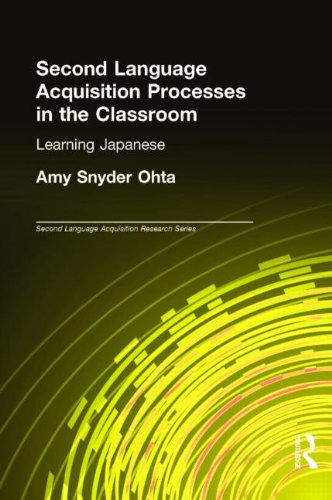
Second Language Acquisition Processes in the Classroom: Learning Japanese (Second Language Acquisition Research Series)
📄 Viewing lite version
Full site ›
Book Details
Author(s)Amy Snyder Ohta
PublisherRoutledge
ISBN / ASIN0805838007
ISBN-139780805838008
AvailabilityUsually ships in 24 hours
Sales Rank9,387,041
CategoryEducation
MarketplaceUnited States 🇺🇸
Description ▲
More Books in Education
Conceptual Physics & Prs $20 Rebate Card Pk
View
Routledge Library Editions: Education Mini-Set H Histo…
View
Emotional and Behavioural Difficulties (Special Educat…
View
Linear Equations, Inequalities, & Functions
View
Unfulfilled Expectations: Home and School Influences o…
View
Study Guide for Foundations of Economics plus MyEconLa…
View
Question Answer Relationships: A Simple Taxonomy of Qu…
View
Routledge Library Editions: Education Mini-Set A: Comp…
View
Routledge Library Editions: Education Mini-Set A: Comp…
View