Internet Environments for Science Education synthesizes 25 years of research to identify effective, technology-enhanced ways to convert students into lifelong science learners--one inquiry project at a time. It offers design principles for development of innovations; features tested, customizable inquiry projects that students, teachers, and professional developers can enact and refine; and introduces new methods and assessments to investigate the impact of technology on inquiry learning.
The methodology--design-based research studies--enables investigators to capture the impact of innovations in the complex, inertia-laden educational enterprise and to use these findings to improve the innovation.
The approach--technology-enhanced inquiry--takes advantage of global, networked information resources, sociocognitive research, and advances in technology combined in responsive learning environments.
Internet Environments for Science Education advocates leveraging inquiry and technology to reform the full spectrum of science education activities--including instruction, curriculum, policy, professional development, and assessment. The book offers:
*the knowledge integration perspective on learning, featuring the interpretive, cultural, and deliberate natures of the learner;
*the scaffolded knowledge integration framework on instruction summarized in meta-principles and pragmatic principles for design of inquiry instruction;
*a series of learning environments, including the Computer as Learning Partner (CLP), the Knowledge Integration Environment (KIE), and the Web-based Inquiry Science Environment (WISE) that designers can use to create new inquiry projects, customize existing projects, or inspire thinking about other learning environments;
*curriculum design patterns for inquiry projects describing activity sequences to promote critique, debate, design, and investigation in science;
*a partnership model establishing activity structures for teachers, pedagogical researchers, discipline experts, and technologists to jointly design and refine inquiry instruction;
*a professional development model involving mentoring by an expert teacher;
*projects about contemporary controversy enabling students to explore the nature of science;
*a customization process guiding teachers to adapt inquiry projects to their own students, geographical characteristics, curriculum framework, and personal goals; and
*a Web site providing additional links, resources, and community tools at www.InternetScienceEducation.org
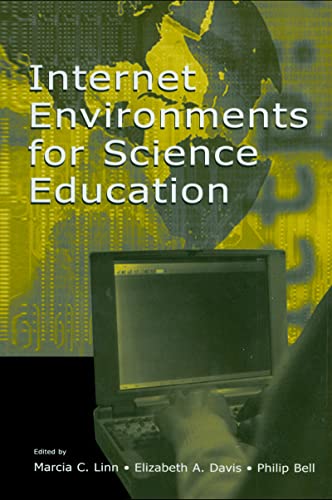
Internet Environments for Science Education
📄 Viewing lite version
Full site ›
Book Details
Author(s)Marcia C. Linn
PublisherRoutledge
ISBN / ASIN0805843027
ISBN-139780805843026
AvailabilityUsually ships in 24 hours
Sales Rank8,251,319
CategoryHardcover
MarketplaceUnited States 🇺🇸
Description ▲
More Books in Hardcover
The Call of the Wild (Puffin Classics)
View
Tacit and Explicit Knowledge
View
Performance, Ethics and Spectatorship in a Global Age …
View
Bad News - Volumes 1 and 2 (Routledge Revivals) (Routl…
View
Drug Transport in Antimicrobial and Anticancer Chemoth…
View
Out of Bounds: Anglo-Indian Literature and the Geograp…
View
The Voices of Romance: Studies in Dialogue and Charact…
View
Converging Streams: Art of the Hispanic and Native Ame…
View
What Handwriting Tells You About Yourself, Your Friend…
View