Despite calls for a more preventive and developmental mode of functioning, school counseling has tended to be driven by a reactive and sometimes crisis orientation. Like social workers and school, counseling, and clinical psychologists, school counselors typically function to alleviate deficits, often in a small percentage of the students they serve. Although this orientation has served school counselors well in many instances, it is not empowering, it does not serve all students, and it does not replace those deficits with the type of positive characteristics and abilities that schools are attempting to develop.Â
Â
This is the first book to provide a comprehensive look at the theory, research, and intervention strategies that comprise a strengths-based, developmental approach to school counseling. In keeping with ASCA recommendations, the Strengths-Based School Counseling (SBSC) framework discusses academic, personal/social and career development outcomes for all students at the elementary, middle and secondary school levels. Other key features include:
Â
integrative framework—SBSC builds upon contemporary research from a variety of areas: school counseling, developmental psychology, school psychology, education, positive psychology, resiliency, and social work.Â
Â
evidence-based interventions—detailed examples of successful evidence-based interventions and environments are presented at the elementary, middle, and high school levels for each major developmental area (academic, personal/social, and career) identified in ASCA’s National Model.Â
Â
readability and pedagogy—beautifully written, the text includes lists of key points, tables of student strengths, illustrative examples, and student exercises.
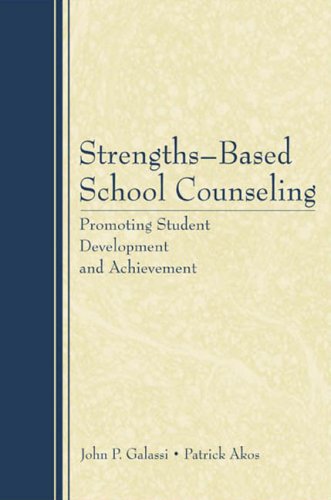
Strengths-Based School Counseling: Promoting Student Development and Achievement
📄 Viewing lite version
Full site ›
Book Details
Author(s)John P. Galassi, Patrick Akos
PublisherRoutledge
ISBN / ASIN0805862498
ISBN-139780805862492
AvailabilityUsually ships in 2 to 3 weeks
Sales Rank98,022
CategoryEducation
MarketplaceUnited States 🇺🇸
Description ▲
More Books in Education
Learning to Teach Science in the Secondary School: A C…
View
The Democracy Reader (IDEA (International Debate Educa…
View
Promoting Student Success Through Group Interventions
View
Co-Teaching That Works: Structures and Strategies for …
View
Humor in Children's Lives: A Guidebook for Practitione…
View
Tensions in Teacher Preparation: Accountability, Asses…
View
Scott Foresman-Addison Wesley Mathematics, Grade 6: Pr…
View
The Engineer of 2020: Visions of Engineering in the Ne…
View