Jimmy Carter inherited a deeply troubled economy. Inflation had been on the rise since the Johnson years, and the oil crisis Carter faced was the second oil price shock of the decade. In addition, a decline in worker productivity and a rise in competition from Germany and Japan compounded the nation's economic problems. The resulting anti-inflation policy that was forced on Carter included controlling public spending, limiting the expansion of the welfare state, and postponing popular tax cuts. Moreover, according to Biven, Carter argued that the ambitious policies of the Great Society were no longer possible in an age of limits and that the Democratic Party must by economic necessity become more centrist.
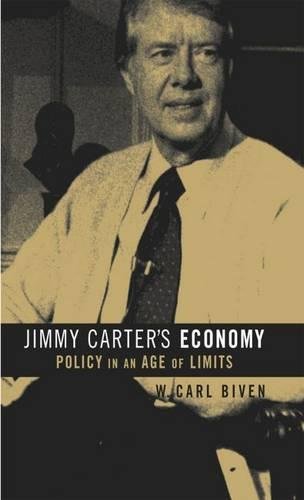
Jimmy Carter's Economy: Policy in an Age of Limits (The Luther H. Hodges Jr. and Luther H. Hodges Sr. Series on Business, Entrepreneurship, and Public Policy)
📄 Viewing lite version
Full site ›
35.86
USD
🛒 Buy New on Amazon 🇺🇸
Book Details
Author(s)W. Carl Biven,
ISBN / ASIN080782738X
ISBN-139780807827383
Sales Rank2,701,511
CategoryBusiness & Economics
MarketplaceUnited States 🇺🇸
Description ▲
The massive inflation and oil crisis of the 1970s damaged Jimmy Carter's presidency. In Jimmy Carter's Economy, Carl Biven traces how the Carter administration developed and implemented economic policy amid multiple crises and explores how a combination of factors beyond the administration's control came to dictate a new paradigm of Democratic Party politics.
More Books in Business & Economics
Business Cycles and Forecasting
View
Development Economics: Its Position in the Present Sta…
View
Cost Systems Design
View
So You Want to Dance on Broadway
View
The Blueprint: Reviving Innovation, Rediscovering Risk…
View
Managing IT Outsourcing, Second Edition
View
Education and the Creation of Capital in the Early Ame…
View
Global Corruption Report 2005: Special Focus: Corrupti…
View
More Tales for Trainers: Using Stories and Metaphors t…
View
Advertising, Society and Consumer Culture
View