Rodriguez-Mangual examines Cabrera's ethnographic essays and short stories in context. By blurring fact and fiction, anthropology and literature, Cabrera defied the scientific discourse used by other anthropologists. She wrote of Afro-Cubans not as objects but as subjects, and in her writings, whiteness, instead of blackness, is gazed upon as the "other." As Rodriguez-Mangual demonstrates, Cabrera rewrote the history of Cuba and its culture through imaginative means, calling into question the empirical basis of anthropology and placing Afro-Cuban contributions at the center of the literature that describes the Cuban nation and its national identity.
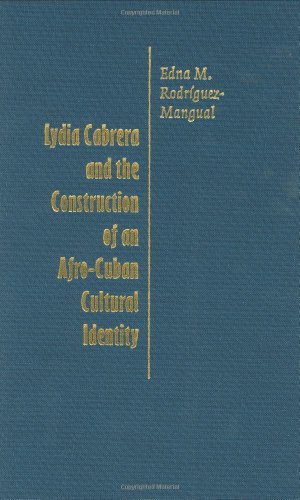
Lydia Cabrera and the Construction of an Afro-Cuban Cultural Identity (Envisioning Cuba)
📄 Viewing lite version
Full site ›
Book Details
Author(s)Edna M. Rodriguez-Mangual
ISBN / ASIN0807828874
ISBN-139780807828878
AvailabilityUsually ships in 24 hours
Sales Rank3,617,567
CategoryLiterary Criticism
MarketplaceUnited States 🇺🇸
Description ▲
Lydia Cabrera (1900-1991), an upper-class white Cuban intellectual, spent many years traveling through Cuba collecting oral histories, stories, and music from Cubans of African descent. Her work is commonly viewed as an extension of the work of her famous brother-in-law, Cuban anthropologist Fernando Ortiz, who initiated the study of Afro-Cubans and the concept of transculturation. Here, Edna Rodriguez-Mangual challenges this perspective, proposing that Cabrera's work offers an alternative to the hegemonizing national myth of Cuba articulated by Ortiz and others.
More Books in Literary Criticism
Egyptian Literature
View
Utopia Paraiso E Historia: Inscripciones Del Mito En G…
View
Nation, State, and Empire in English Renaissance Lite…
View
On the Outskirts of Form: Practicing Cultural Poetics
View
Genre at the Crossroads: The Challenge of Fantasy
View
Profiles in Canadian Drama: James Reaney
View
Monty Python, Shakespeare and English Renaissance Drama
View
Modes of Faith: Secular Surrogates for Lost Religious …
View
Latino Los Angeles in Film and Fiction: The Cultural P…
View