Schweitzer begins with Aristotle's ideal of "perfect" friendship that positions freely chosen relationships among equals as the highest realization of ethical, social, and political bonds. Evidence in works by John Winthrop, Hannah Foster, James Fenimore Cooper, and Catharine Sedgwick confirms that this classical model shaped early American concepts of friendship and, thus, democracy. Schweitzer argues that recognizing the centrality of friendship as a cultural institution is critical to understanding the rationales for consolidating power among white males in the young nation. She also demonstrates how women, nonelite groups, and minorities have appropriated and redefined the discourse of perfect friendship, making equality its result rather than its requirement. By recovering the public nature of friendship, Schweitzer establishes discourse about affection and affiliation as a central component of American identity and democratic community.
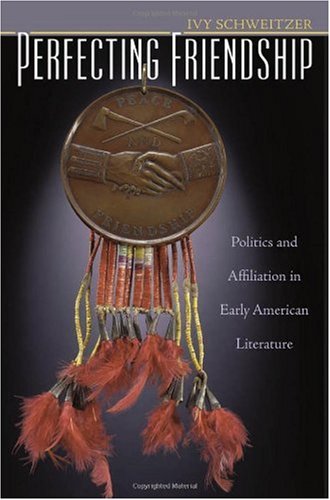
Perfecting Friendship: Politics and Affiliation in Early American Literature
📄 Viewing lite version
Full site ›
⌛ 🇫🇷 France pricing being fetched…
Prices will appear once fetched — usually within a few minutes.
View in:
🇺🇸 USA
Book Details
Author(s)Ivy Schweitzer
ISBN / ASIN0807830690
ISBN-139780807830697
MarketplaceFrance 🇫🇷
Description ▲
Contemporary notions of friendship regularly place it in the private sphere, associated with feminized forms of sympathy and affection. As Ivy Schweitzer explains, however, this perception leads to a misunderstanding of American history. In an exploration of early American literature and culture, Schweitzer uncovers friendships built on a classical model that is both public and political in nature.